Partly. Google Search Console's generative AI report, Bing's AI Performance report and ChatGPT Business Hub are free, but each covers only its own engines and none shows the answer text. For a first audit of 10 to 20 questions, a free LLM SEO tool trial or a spreadsheet will do.
Back to all blogs Last updated: 11.27.2026
What does an LLM SEO tool do, and how do you run one week to week?
CN
By CogNerd TeamAn LLM SEO tool asks AI engines your buyers' questions on a schedule and logs mentions, citations and sources. 6 checks before you buy, plus a weekly routine.
Key Takeaways
- An LLM SEO tool measures your presence in AI answers, shows why you are missing, and points to the fix. Most buyers only test the first.
- Google, Bing and OpenAI each give a free AI report for their own engines. From 1 Feb 2027 Bing also honors a per-page AI grounding setting.
- Before you buy, check the questions, engines, branded split, citations, run health and raw answers.
- In three CogNerd scans, engines named the brand in 14.5% to 25% of answers and linked its own site in 1.4% to 5.8%.
An LLM SEO tool asks ChatGPT, Gemini, Perplexity, Claude and other AI engines the questions your buyers ask, on a schedule, and records whether each answer names your brand, links your site and gets your facts right. A good one shows which sources won instead of you, keeps every raw answer, and flags failed runs.
What does an LLM SEO tool actually do?
Twenty questions in five AI engines is 100 answers to log by hand every week, and an LLM SEO tool does that logging. It sends fixed questions to engines such as ChatGPT, Gemini and Perplexity, stores every answer, and counts mentions, citations and errors over time. The better ones trace each gap to a page or source you can change.
LLM SEO is the practice; the tool is how you keep doing it, because most manual efforts stop after the first week of logging. It does three jobs.
| Job of an LLM SEO tool | What the tool does | What you should get out of it |
|---|---|---|
| Measure | Runs your questions on a schedule across named engines, stores each answer | Mention rate, own-site citation rate, accuracy, per engine and question |
| Diagnose | Extracts the brands and URLs each answer named or cited | The pages and sites that win the questions you lose |
| Act | Turns a lost question into a task: answer page, fact correction, listing, crawler fix | A dated fix list you can ship this week |
Measuring alone is what an AI visibility tracker does. For the wider stack, free first-party reports included, start with our guide to GEO tools.
What do the free AI performance reports in Search Console, Bing and ChatGPT show?
Google Search Console, Bing Webmaster Tools and ChatGPT Business Hub each give a free AI report, so connect all three before paying for an LLM SEO tool. Each report sees only its own engines and none shows the answer a buyer read. From 1 Feb 2027 Bing also honors a per-page AI grounding setting.
Access is the newer problem. On 30 Oct 2026 Microsoft announced separate preferences for AI training and AI grounding. In Microsoft's words, grounding "covers using content as input to help inform AI-generated responses." Each page can say whether it may ground answers in Bing, Copilot and Microsoft 365, separately from training and without affecting Bing search eligibility. Allow is the default.
A page can rank in Bing and still never ground a Copilot answer, and no visibility score will say why. An LLM SEO tool has to read that setting per page, next to robots.txt.
| Free AI report (checked 19 Nov 2026) | AI engines covered | What it shows | What it does not show |
|---|---|---|---|
| Google Search Console, generative AI performance report | AI Overviews, AI Mode, Discover AI features | Impressions by page, country, device and date; all sites worldwide since 31 Aug 2026 | Clicks, the query, the answer text, other engines |
| Bing Webmaster Tools, AI Performance | Microsoft Copilot, AI summaries in Bing, select partners | Citations per URL, grounding queries, topics and opportunity queries (beta) | Unlinked mentions, the answer text, non-Microsoft engines |
| ChatGPT Business Hub | ChatGPT | Mentions and website clicks over the past 28 days, discovery topics, for verified businesses | Your exact questions, competitors' answers, other engines |
The right-hand column is the gap an LLM SEO tool has to fill. For the Google side in depth, read our post on Search Console's AI reports.
How do you choose the best LLM SEO tools? 6 checks
The best LLM SEO tools pass six checks: your own fixed questions, named engines, a branded and unbranded split, own-site citations, run health and raw answers. Together they show how a tool collects the answers under its headline score. In three CogNerd scans, engines linked the brand's own site in only 1.4% to 5.8% of answers.
Four of the six (fixed questions, named engines, the branded split and raw answers) are in our 0-to-2 scoring sheet to compare AI visibility tools. Our AI visibility score post shows how a blended rate hides a zero. The two below matter most for LLM SEO.
Citations of your own site, not only mentions
A mention names you; a citation links your page and sends a visitor. For an online business, ChatGPT Business Hub counts only the link, so the brand name alone does not register. Ask for both rates and the URLs cited instead of yours.
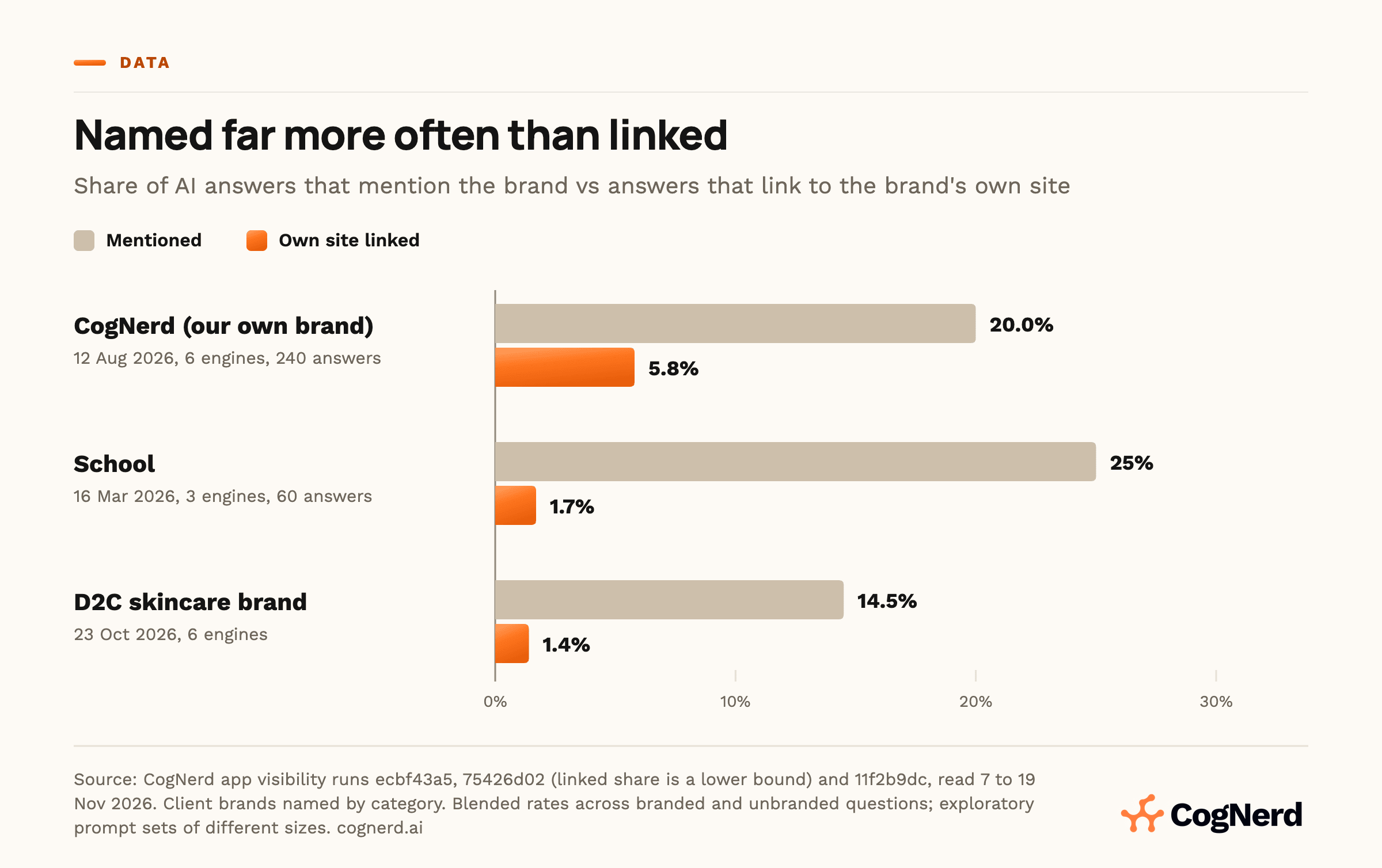 Figure 1. Named far more often than linked. Source: CogNerd runs ecbf43a5 (12 Aug 2026, 6 engines, 240 answers), 75426d02 (16 Mar 2026, 3 engines, 60 answers; linked share a lower bound), 11f2b9dc (23 Oct 2026, 6 engines, none from Gemini). Clients by category; branded and unbranded blended.
Run health on every report
Each run should report answers returned and failed calls per engine. Engines time out and rate-limit, and a run that quietly lost a third of its answers moves your score for reasons unrelated to your content.
Before any demo, ask us for your own mentioned vs linked split, with answers returned and failed calls shown per engine. Then hold every vendor's sample report to the same two checks.
From our scans: can you trust an LLM visibility tracking score?
An LLM visibility tracking score is only as good as the run under it. On 23 Oct 2026 a CogNerd scan for a D2C skincare brand lost 79 calls and every Gemini answer, yet still produced a GEO Score of 30.0. The complete rescan on 7 Nov scored 29.4. Read run health first.
- A D2C skincare brand (client). The 23 Oct 2026 scan returned 138 answers from six engines; 79 calls failed and Gemini returned nothing. The 7 Nov rescan of the same questions returned 212 answers, none failed. GEO Score: 30.0, then 29.4. The score barely moved, but it now rests on 74 more answers, so the 7 Nov run is the baseline to track from.
- CogNerd itself. Our scans on 25 Sep and 5 Oct 2026 recorded 0 responses. The last complete reading we have is still 12 Aug.
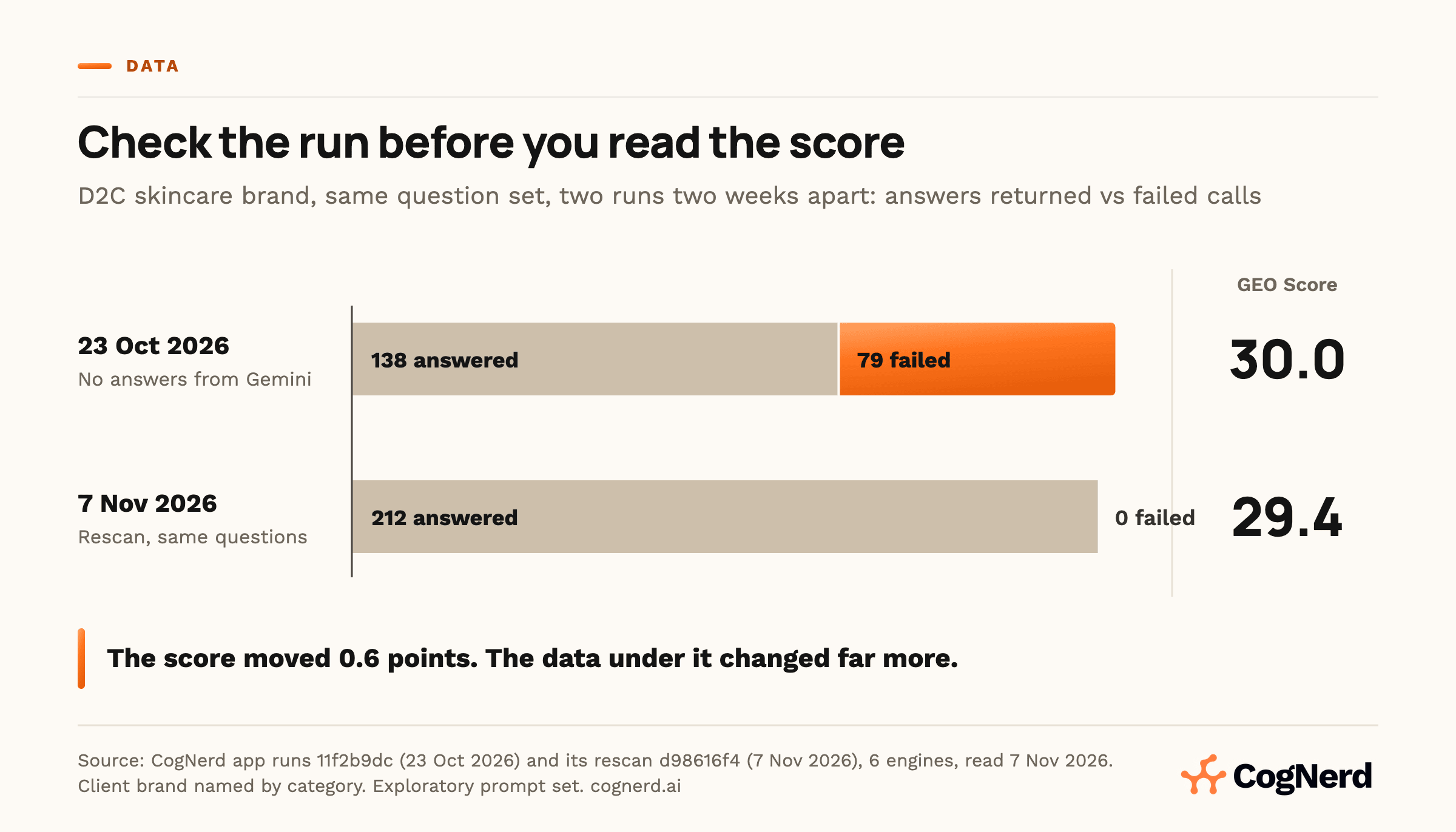 Figure 2. Check the run before you read the score. Source: CogNerd runs 11f2b9dc (23 Oct 2026) and rescan d98616f4 (7 Nov 2026), 6 engines. Client by category; exploratory prompt set.
When did your current tool last show you a failed call?
How do you track LLM visibility with an LLM SEO tool each week?
Run an LLM SEO tool weekly, act only on questions that move two runs in a row, and ship one fix a week. Answers wobble: SparkToro found less than a 1 in 100 chance that ChatGPT or Google's AI returns the same list of brands twice for the same prompt. Treat any single answer as noise.
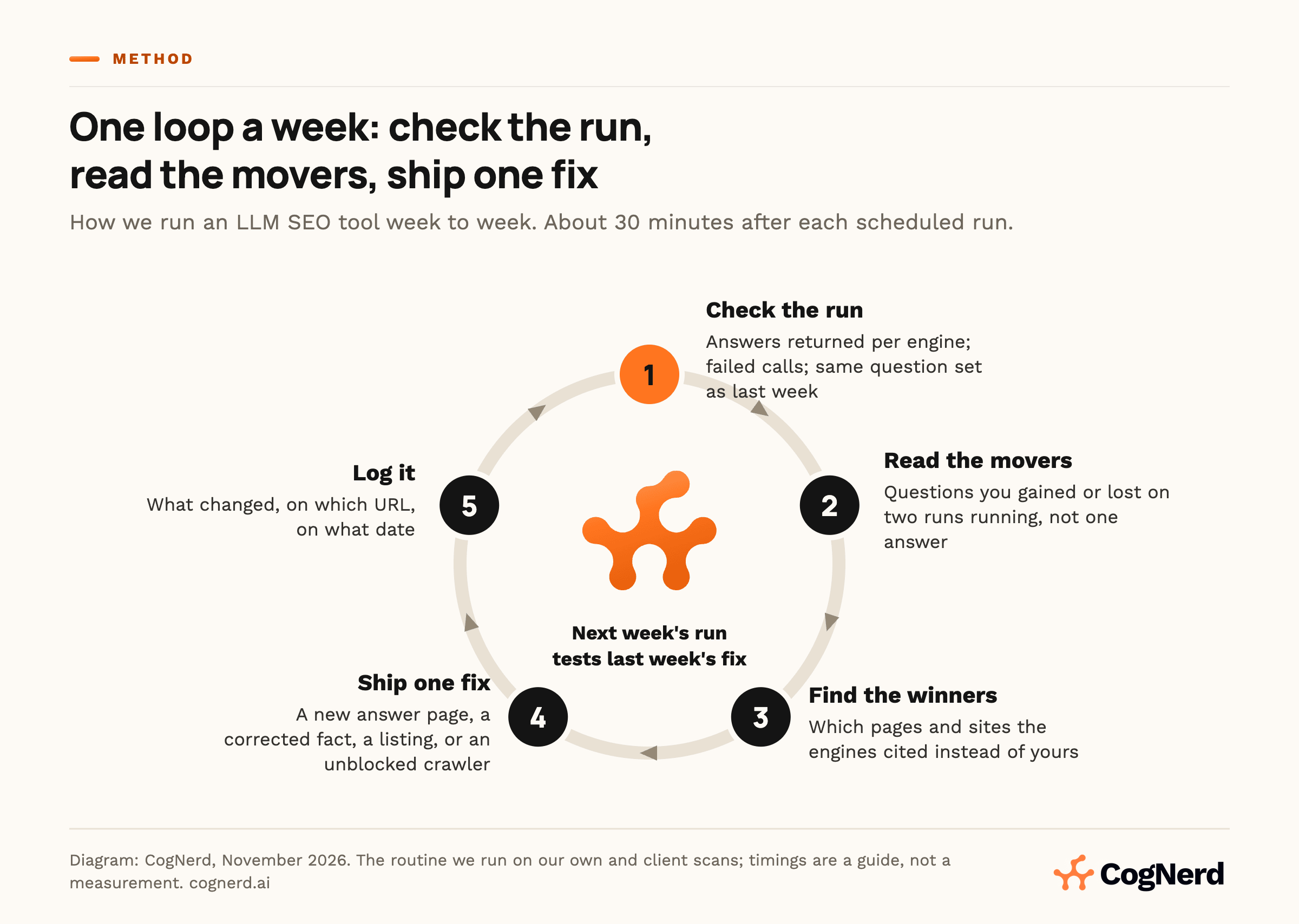 Figure 3. One loop a week. Diagram: CogNerd, Nov 2026; timings are a guide, not a measurement.
- Check the run (5 minutes). Answers per engine, failed calls, same question set. Incomplete? Rerun before reading anything.
- Read the movers (10 minutes). Sort by change. Keep questions gained or lost two runs running; ignore one-off swings.
- Find the winners (5 minutes). For each lost question, list the pages the engines cited. The fix is usually a better version of their page, or a listing on the site they trust.
- Ship one fix (the rest of the week). A new answer page, a corrected fact across your profiles, a directory listing, or a crawler rule. For page format, see our guide to writing content AI models prefer.
- Log it (5 minutes). What changed, which URL, which date. Three weeks on, the log is how you tell which fix moved which question.
| Cadence (LLM SEO tool routine) | What to do | Why |
|---|---|---|
| Weekly | Run the loop above | Catches failed runs and new competitors early |
| Monthly | Compare unbranded mention and citation rates per engine with last month; export the free reports | Long enough for a page fix to show; exports keep a history you control |
| Quarterly | Add new buyer questions as a new version; run the old version one more month | Compares old and new sets before switching |
Where does CogNerd fit among LLM SEO tools?
CogNerd sells an LLM SEO tool and AEO/GEO services, so weigh this section accordingly. As of Nov 2026 the CogNerd platform runs your questions across 5+ AI engines, splits branded from unbranded, lists cited sources, shows answers returned and failed per run, and turns lost questions into content briefs.
Our SEO and AEO services team can run the weekly loop for you on the same platform. Still comparing? Start from our pillar on the best AI SEO tools and hold every candidate to the six checks, us included.
Get your free AI visibility audit to see where you stand before you pick a tool.
About the author. Aman Mundra is Founder & CEO of CogNerd. He spent about ten years as a machine learning engineer, including four years at PayPal, before building CogNerd to measure how brands appear in AI answers.
Last updated: 20 Nov 2026
Sources
All read 19 Nov 2026.
- Microsoft Bing Blog, Krishna Madhavan, "Your content, your choice: clearer preferences for training and grounding", 30 Oct 2026: https://blogs.bing.com/search/2026/10/your-content-your-choice-clearer-preferences-for-training-and-grounding
- Microsoft Bing Webmaster Blog, "Introducing AI Performance in Bing Webmaster Tools Public Preview", 10 Feb 2026: https://blogs.bing.com/webmaster/2026/02/Introducing-AI-Performance-in-Bing-Webmaster-Tools-Public-Preview
- Google Search Central Blog, "Introducing Search Generative AI performance reports in Search Console", 3 Jun 2026, rollout note dated 31 Aug 2026: https://developers.google.com/search/blog/2026/06/gen-ai-performance-reports
- OpenAI Help Center, "Setting up your business on ChatGPT": https://help.openai.com/en/articles/20001635-setting-up-your-business-on-chatgpt
- SparkToro (Rand Fishkin with Patrick O'Donnell of Gumshoe), "AIs are highly inconsistent when recommending brands or products", Jan 2026: https://sparktoro.com/blog/new-research-ais-are-highly-inconsistent-when-recommending-brands-or-products-marketers-should-take-care-when-tracking-ai-visibility
- CogNerd app visibility runs ecbf43a5, 75426d02, 11f2b9dc and rescan d98616f4 (internal)
- Microsoft Bing Webmaster Blog, "Introducing Topics Portfolio (Beta) in AI Performance", 13 Oct 2026: https://blogs.bing.com/webmaster/2026/10/introducing-topics-portfolio-beta-in-ai-performance
FAQ
Related articles
FAQ
Quick answers on CogNerd, AI search optimization, AEO, GEO and SEO.
See how AI search sees your brand.
Run a free AI visibility scan and see exactly where your brand stands today against your top 3 competitors, engine by engine.
Visibility report
Visibility score
61.4baseline
Engines citing you
2 / 5
Top gap“best {your category} platform”