LLM SEO results arrive unevenly. Retrieval-based answers can change weeks after a brand publishes or fixes a page, while what a model learned in training stays fixed at its cutoff. Run the same questions on the same engines every month and judge the trend, not one scan.
Back to all blogs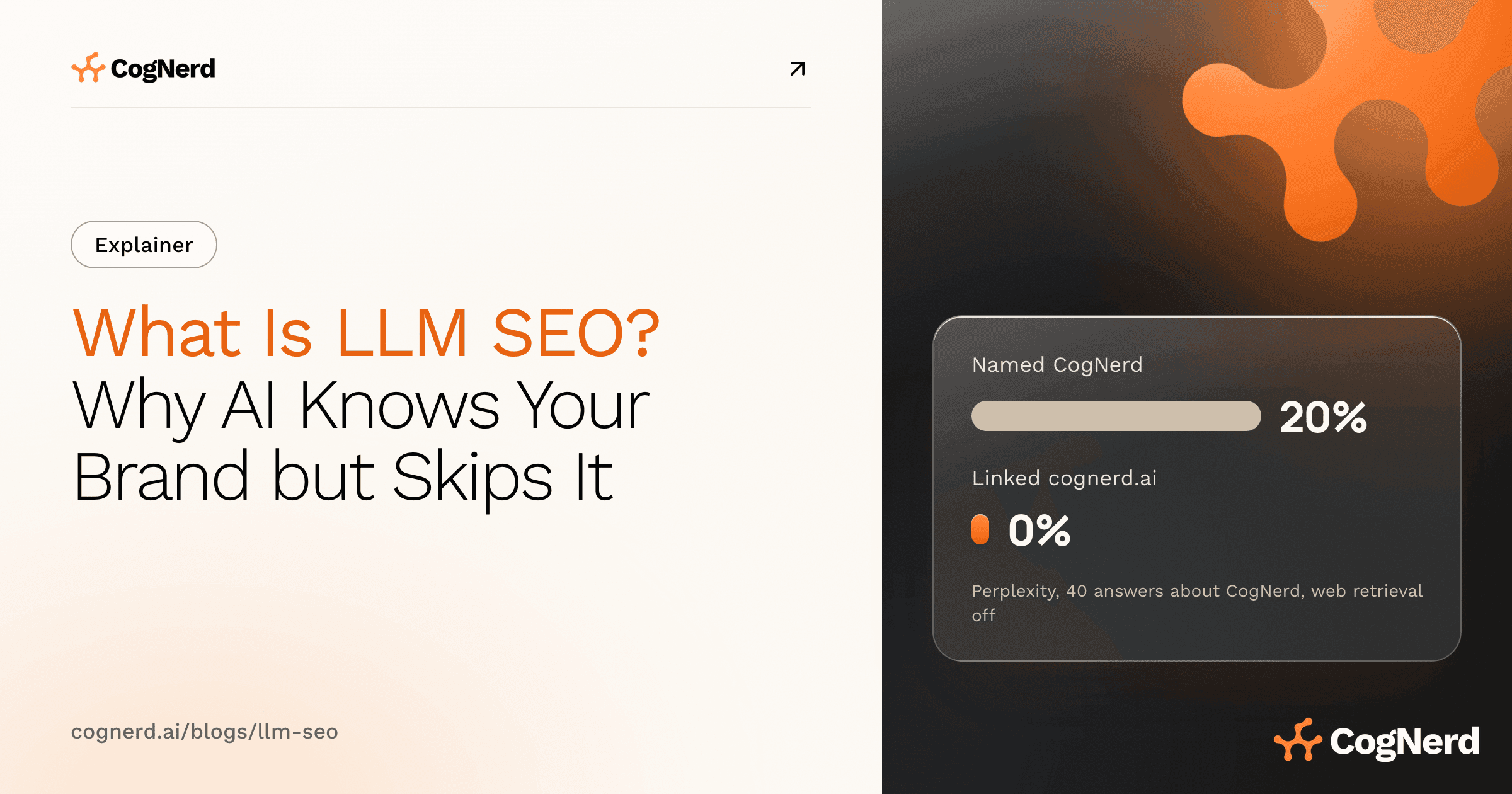 Last updated: 11.23.2026
What is LLM SEO, and how is it different from classic SEO?
CN
By CogNerd TeamLLM SEO gets your brand named and cited by ChatGPT, Gemini and AI Overviews. In one scan, 6 engines named us equally but linked our site from 8 times to never.
Key Takeaways
- Since 10 Nov 2026 OpenAI shows businesses how often ChatGPT mentions them, and for an online business only a reference to the website counts.
- AI answers come from training memory or live retrieval. With retrieval off, six engines each named CogNerd in 8 of 40 answers but linked us from 8 times to never.
- Google says its AI features rest on the same foundations as Search and that llms.txt does nothing there. Fix crawlability and content first.
LLM SEO is the work of getting your brand named, described correctly and cited when people ask ChatGPT, Gemini, Claude, Perplexity or Google's AI Overviews a question. Classic SEO aims for a ranked link. LLM SEO aims for a place inside the written answer, which depends on crawlable pages, direct answers, consistent facts and trusted third-party mentions.
If ChatGPT names your brand but never references your website, does that count as a mention? Since 10 Nov 2026, OpenAI's answer for an online business is no, and most of our own AI mentions would have failed that test.
What is LLM SEO called, and is LLM SEO the same as GEO?
LLM SEO, also called LLMO, is the same discipline as generative engine optimization (GEO) and answer engine optimization (AEO), named from a different angle. LLM stands for large language model, the kind of AI behind ChatGPT, Gemini, Claude and the answers in Google and Perplexity.
Each label comes from a different crowd:
- GEO comes from a 2023 research paper by Aggarwal and colleagues, which reported that targeted content changes could raise a source's visibility in generative answers by up to 40%.
- AEO dates from the featured-snippet and voice-search years, when the goal was being the one answer read aloud.
- LLM SEO and LLMO come from marketers who think about the model first and the search page second.
Our SEO vs AEO vs GEO guide lines the three up, and how generative engine optimization works shows the mechanism.
What is the difference between LLM SEO and traditional SEO?
Traditional SEO wins a ranked link the user may click. LLM SEO wins a place inside the one answer a model writes from several sources. Pew Research Center found that in March 2025, Google visits with an AI summary ended in a result click 8% of the time, against 15% without one.
Table 1. Classic SEO vs LLM SEO (CogNerd, Nov 2026).
| What changes Classic SEO LLM SEO |
| What you win | A ranked link | A mention or citation inside an answer |
| What gets evaluated | The page | Passages within the page, plus what others say about you |
| Who compares options | The user, across ten links | The model, before the user sees anything |
| Main measurement | Rankings, clicks, impressions | Mention rate, citation rate, accuracy, on a fixed question set |
| Brand facts | Helpful | Critical, because wrong facts get repeated |
| Off-site signals | Backlinks | Mentions on sources the model trusts, linked or not |
| First-party reporting | Search Console | Search Console's generative AI report, Bing Webmaster Tools' AI performance report, ChatGPT Business Hub (beta, Nov 2026) |
Only about 1% of visits included a click on a link inside the summary.
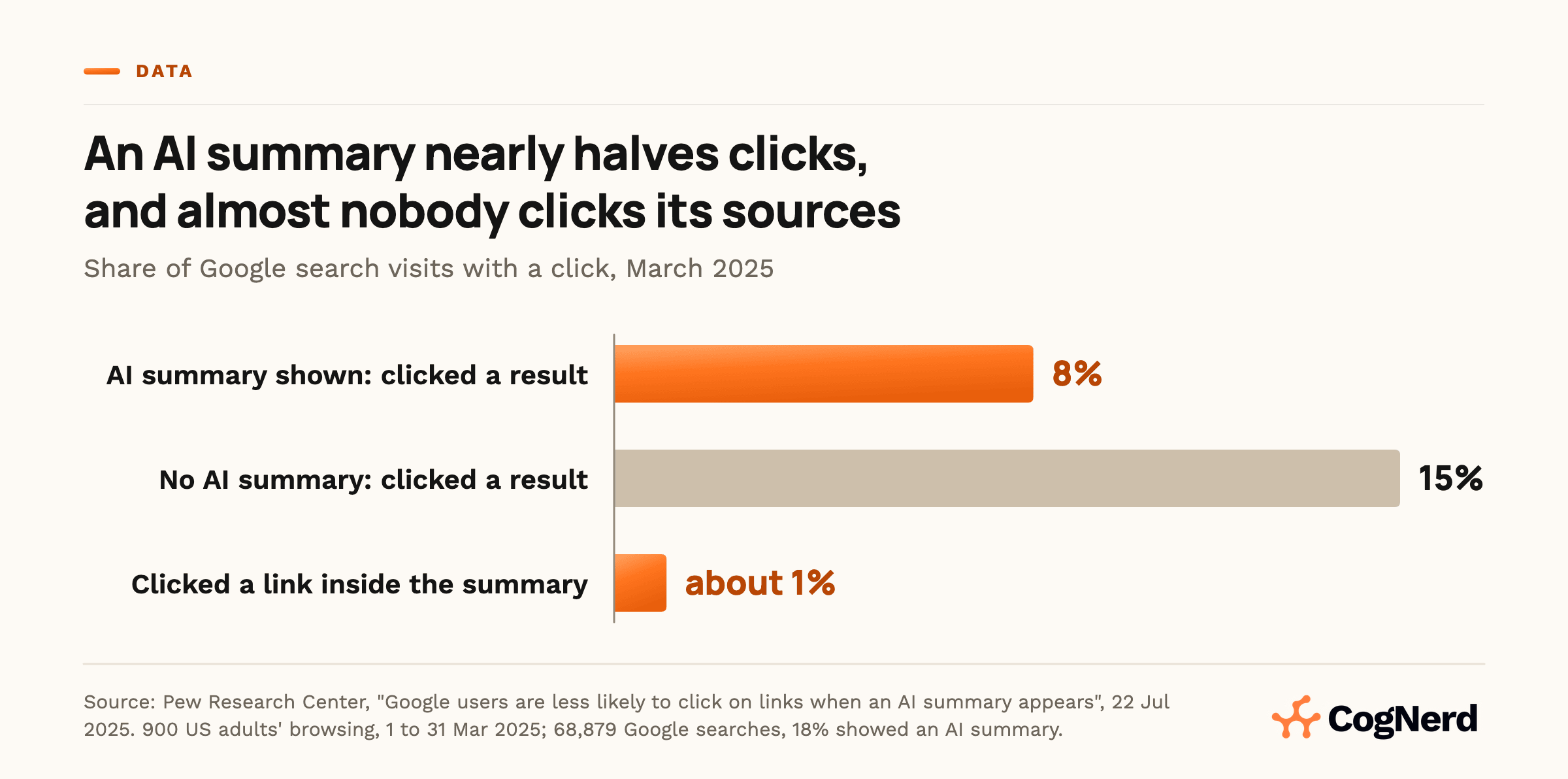 Figure 1. An AI summary nearly halves clicks. Source: Pew Research Center, 22 Jul 2025, 900 US adults, 68,879 Google searches in March 2025, 18% of them with an AI summary.
The longer comparison is in traditional SEO vs AI SEO.
What is ChatGPT Business Hub, and what does it change for LLM SEO?
OpenAI opened Businesses in ChatGPT in beta on 10 Nov 2026. Its Business Hub gives brands their first count of ChatGPT mentions from OpenAI itself: a verified business can update its details and see aggregated mentions, website clicks and discovery topics for the past 28 days.
OpenAI's help center says that for an online business, a mention counts when ChatGPT references the business's website, and the brand name alone doesn't count. For a local business, a mention counts when ChatGPT shows a result for that location.
For LLM SEO, three things follow:
- Citations now have an official scoreboard. A name without your site referenced won't show up in Business Hub.
- It covers one engine. Buyers also ask Gemini, Perplexity, Claude and Google AI Mode.
- Discovery topics are themes, not prompts. Your own question set shows which buyer questions you lose.
OpenAI says more than 1.2 billion people use ChatGPT each week, so claim the profile and correct its facts this week.
Does classic SEO still matter for LLM SEO?
Yes. Google's guide to optimizing for generative AI features says the same SEO foundations apply to AI Overviews and AI Mode: a clear technical structure, unique and helpful content, and normal Search eligibility. The same guide names three things to ignore for Google Search:
- llms.txt and other "AI files". Google added a note in June 2026 saying Google Search ignores them.
- Chunking content for machines. Write for readers. Clear headings and direct answers help them first.
- Inauthentic mentions. Google's core systems focus on quality content and other systems block spam, and its AI features depend on both.
Other engines run their own crawlers, so check you aren't blocking them; our guide on how AI crawlers read your website covers the user agents. Many assistants also retrieve from search indexes when they answer.
How do LLMs decide what to say about a brand?
Large language models (LLMs) talk about a brand from two places: what the model learned in training, fixed at its cutoff, and what the assistant retrieves from the web when it answers. Only the retrieval route responds to what a brand publishes this quarter, so LLM SEO work concentrates there.
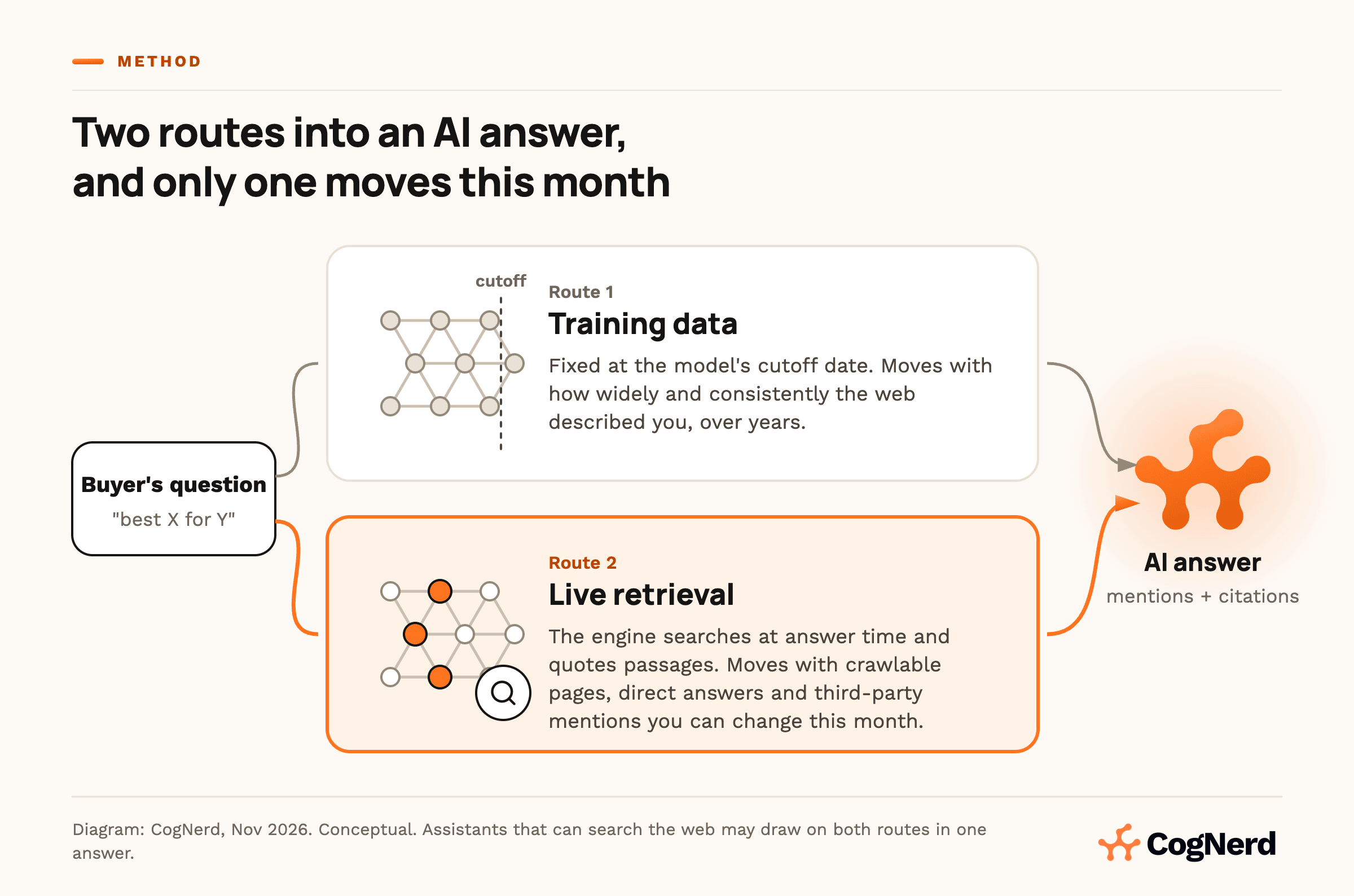 Figure 2. Two routes into an AI answer. Diagram: CogNerd, November 2026. Conceptual, not a vendor specification.
- From training. You can't edit it; it reflects how widely and consistently the web described you, often years ago.
- From retrieval. The assistant searches the web at answer time and writes from the passages that answer the question.
Which route did our own mentions come from?
From our scans: do AI engines name and link a brand the same way?
Naming matched; linking did not. On 12 Aug 2026 CogNerd scanned cognerd.ai with web retrieval off, so answers came from training alone: 40 buyer questions, six engines (ChatGPT, Claude, Gemini, Perplexity, Grok, DeepSeek), one answer each (run ecbf43a5). Every engine named CogNerd in 8 of 40 answers; links to cognerd.ai ranged from 8 to zero.
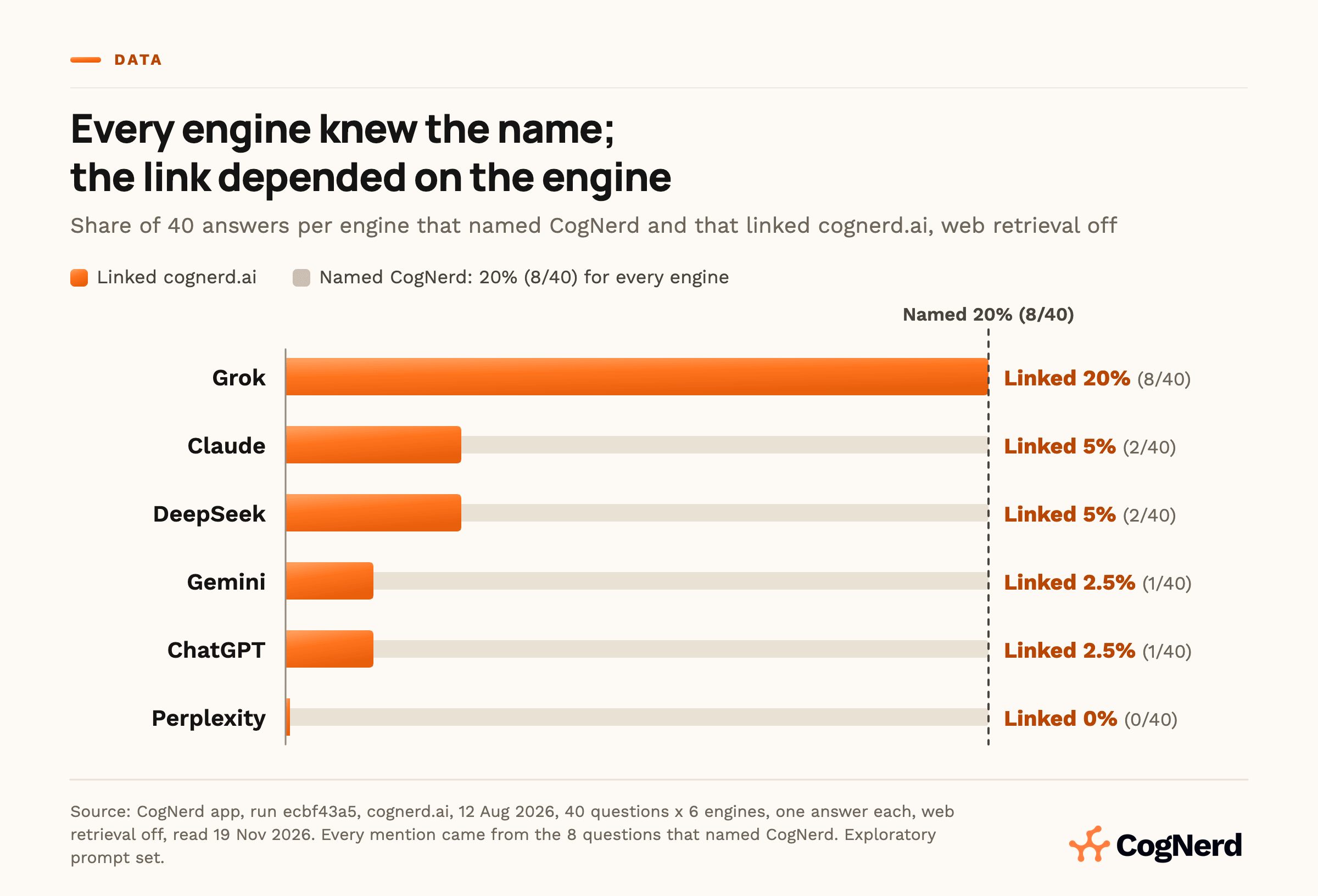 Figure 3. Every engine knew the name; the link depended on the engine. Source: CogNerd app, run ecbf43a5, cognerd.ai, 12 Aug 2026, 40 questions x 6 engines, one answer each, web retrieval off, read 19 Nov 2026. Exploratory prompt set.
| Engine (run ecbf43a5, 12 Aug 2026, retrieval off) Answers naming CogNerd Answers linking cognerd.ai |
| Grok | 8 of 40 | 8 of 40 |
| Claude | 8 of 40 | 2 of 40 |
| DeepSeek | 8 of 40 | 2 of 40 |
| Gemini | 8 of 40 | 1 of 40 |
| ChatGPT | 8 of 40 | 1 of 40 |
| Perplexity | 8 of 40 | 0 of 40 |
- Every engine named us on the same 8 questions (20%), the ones that already contained our name. No model volunteered the brand unprompted.
- Links varied by engine. Grok linked our site 8 times (20%). Perplexity, built around live search, gave no link at all with retrieval off.
- The fix is on the retrieval side. You can't edit what a model memorized, but you can publish the pages and listings retrieval reads this month.
The branded vs unbranded split from this run is in how generative engine optimization works.
Want this split for your own brand? Ask us for your per-engine named-vs-linked cut before you plan next quarter's pages.
How do you do LLM SEO? 5 steps, in order
LLM SEO takes five steps: list buyer questions, measure mention, citation and accuracy across engines, answer each question on a page, make brand facts match everywhere, and earn mentions on sources models read. Repeat monthly on the same questions; a fix can take weeks to show.
- List the questions. Write 10 to 20 buyer questions, at least two thirds without your brand name. Mix "best X for Y", "X vs Y", "how do I" and "is X worth it".
- Measure where you stand. Ask each question in your buyers' engines and record mention, citation and accuracy, branded and unbranded apart. Our AI visibility audit guide has the checklist, and the AI visibility score shows how to roll it into one number without hiding the split.
- Answer each question on a page. Use the question as a heading, put a 40 to 60 word direct answer under it, then the detail, a table and your own evidence.
- Make your facts match everywhere. Your site, Google Business Profile, ChatGPT Business Hub profile, LinkedIn and directories should agree.
- Earn mentions where models look. Industry directories, review sites, comparison articles and community threads; fix listings before posting in threads. Our guide on how to get mentioned by ChatGPT lists the source types that show up most.
What LLM SEO mistakes should you avoid?
Three LLM SEO mistakes to avoid: writing for the model instead of the reader, reporting one blended mention rate, and buying shortcuts such as llms.txt files, "AI schema" packs or planted mentions. Stuffed pages read worse to people. A blended number lets branded questions hide an unbranded rate of zero, and Google says the shortcuts don't change its AI features.
Which of the three is in your current report?
Do you need an LLM SEO tool?
Not for the first LLM SEO audit, which you can run by hand. Repeating it is the hard part: 15 questions on four engines is 60 answers to log every month. An LLM SEO tool runs the questions on a schedule, records mentions, citations and sources, and keeps the history.
CogNerd does this across 5+ AI engines, including ChatGPT, Gemini, Perplexity and Claude, separates branded from unbranded results, and turns the gaps into content briefs. For the wider playbook, see our AI SEO guide.
Get your free AI visibility audit to see your branded and unbranded starting point. Prefer to hand it off? Our guide covers how to choose an AI SEO agency in India, and its seven questions apply in any market.
About the author. Aman Mundra is Founder & CEO of CogNerd. He spent about ten years as a machine learning engineer, including four years at PayPal, before building CogNerd to measure how brands appear in AI answers.
Last updated: 20 Nov 2026
Sources
- OpenAI, "Introducing Businesses in ChatGPT in beta", OpenAI Developer Community, 10 Nov 2026: https://community.openai.com/t/introducing-businesses-in-chatgpt-in-beta/1414865
- OpenAI Help Center, "Setting up your business on ChatGPT", read 19 Nov 2026: https://help.openai.com/en/articles/20001635-setting-up-your-business-on-chatgpt
- OpenAI, "ChatGPT Ads expands to 26 new countries", read 19 Nov 2026: https://openai.com/index/chatgpt-ads-expands-26-new-countries
- Google Search Central, "Optimizing for generative AI features on Google Search", llms.txt note added June 2026 (page last updated 10 Jul 2026), read 19 Nov 2026: https://developers.google.com/search/docs/fundamentals/ai-optimization-guide
- Pew Research Center, "Google users are less likely to click on links when an AI summary appears in the results", 22 Jul 2025: https://www.pewresearch.org/short-reads/2025/07/22/google-users-are-less-likely-to-click-on-links-when-an-ai-summary-appears-in-the-results/
- Aggarwal et al., "GEO: Generative Engine Optimization", arXiv 2311.09735: https://arxiv.org/abs/2311.09735
- Search Engine Journal, "SEO Pulse: Core Update, ChatGPT Business Hub & AI Mode's New Model", 14 Nov 2026: https://www.searchenginejournal.com/seo-pulse-core-update-chatgpt-business-hub-ai-modes-new-model/597135
- CogNerd app, run ecbf43a5 (cognerd.ai, 12 Aug 2026, 6 engines, web retrieval off), per-engine results read 19 Nov 2026 (internal)
FAQ
Related articles
FAQ
Quick answers on CogNerd, AI search optimization, AEO, GEO and SEO.
See how AI search sees your brand.
Run a free AI visibility scan and see exactly where your brand stands today against your top 3 competitors, engine by engine.
Visibility report
Visibility score
61.4baseline
Engines citing you
2 / 5
Top gap“best {your category} platform”