A small business can start generative engine optimization with free tools only: Search Console's Generative AI report, Bing Webmaster Tools' AI Performance report and GA4. Add one prompt tracker when you need ChatGPT, Perplexity, Claude or Gemini app data, and trial it on 20 buyer questions, at least 15 of them unbranded.
Back to all blogs Last updated: 11.20.2026
Which generative engine optimization tools do you actually need?
CN
By CogNerd TeamGenerative engine optimization tools sorted by the job they do. One scan of our site read 27%, 20%, 5.8% or 0%, all correct. Start free, then add a tracker.
Key Takeaways
- Most "best GEO tools" lists rank vendors. Sort tools by the job they do and you will buy less.
- Google and Microsoft now give GEO data away, including Bing's Topics Portfolio (since 13 Oct 2026) of queries where other sites are cited and yours is not.
- One scan of our site read 27%, 20%, 5.8% or 0%, all correct. Ask what a tool's headline counts.
Short answer: Cover six jobs: let AI crawlers in, read Google's and Bing's own AI reports, monitor AI answers, trace cited sources, fix content and markup, and count visits from AI. Jobs one, two and six cost nothing. A paid tracker earns its place on the engines Google and Bing don't report on, such as ChatGPT and Perplexity.
Six AI engines named CogNerd in 48 of 240 answers on 12 Aug 2026, and in none of the 192 answers to unbranded questions. A GEO tool could report that run as 27% and be accurate. Which number would yours show you?
What is a generative engine optimization tool?
A generative engine optimization tool shows or improves how often AI answer engines mention, cite or link to your brand. An AI answer passes through several steps: the engine fetches your page, picks it as a source, quotes it and sometimes sends a click. Each step needs its own instrument.
New to GEO? Start with what GEO is, then our complete guide to generative engine optimization for the strategy.
What do the Bing AI Performance and Search Console generative AI reports show?
Bing's AI Performance report (public preview since 10 Feb 2026) counts citations across Microsoft Copilot, AI-generated summaries in Bing and select partner integrations. Search Console's Generative AI performance report (3 Jun 2026) shows impressions in AI Overviews and AI Mode by page, country, device and date.
On 13 Oct 2026 Microsoft added Topics Portfolio, a beta tab in that report. It groups the grounding queries where your site appears into topics, shows how many sites are cited in each, and lists "Opportunity Queries": the strongest queries where other sites appear and yours does not. Ask any paid tool what it shows beyond that.
What should generative engine optimization tools do?
Generative engine optimization tools should cover six jobs: let AI crawlers in, read Google's and Bing's AI data, monitor AI answers, trace cited sources, fix content and markup, and count visits from AI. Free first-party tools handle jobs 1, 2 and 6; each paid vendor below claims two to four of the six.
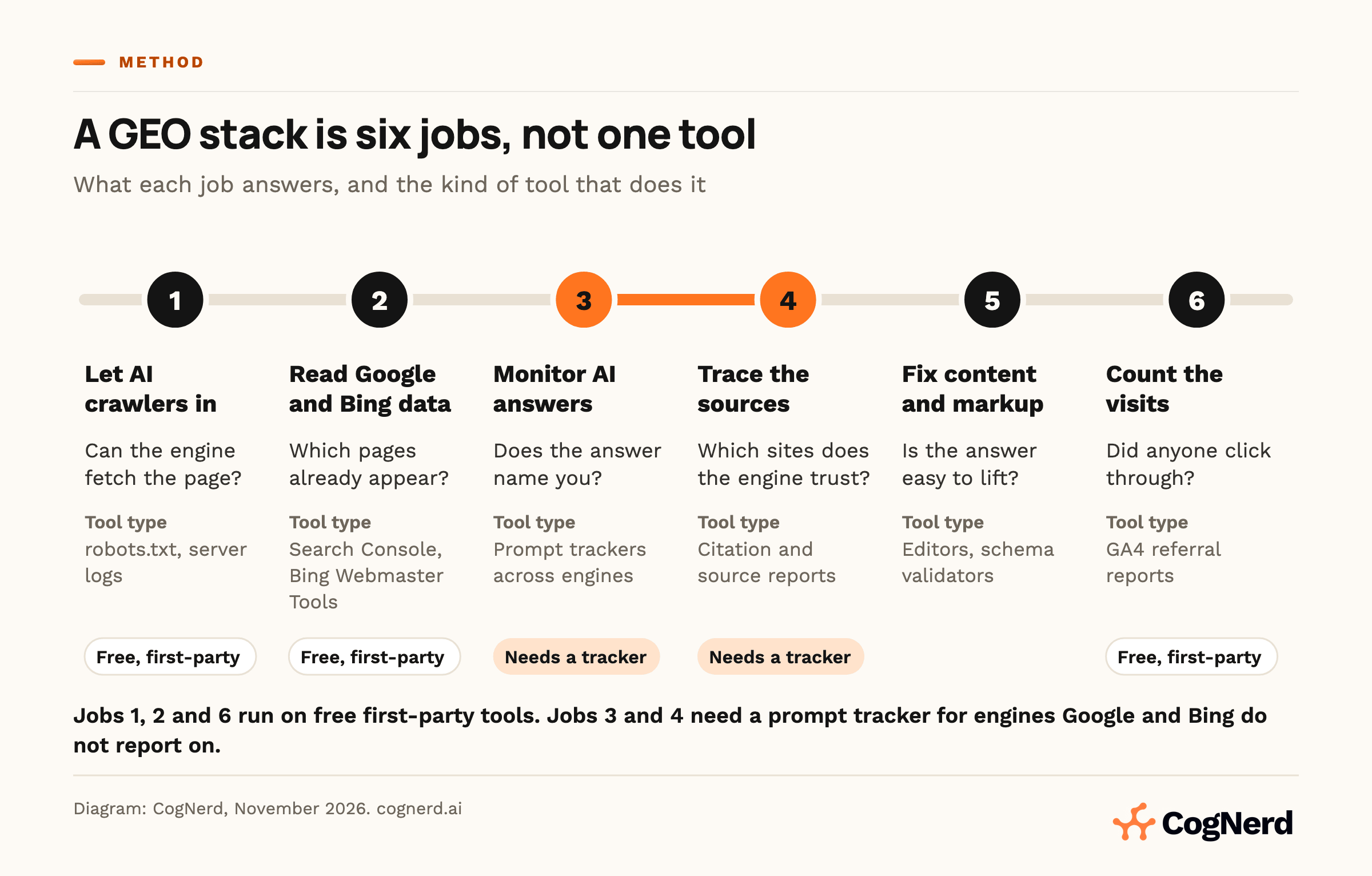
Figure 1. The six jobs and the kind of tool for each. Diagram: CogNerd, Nov 2026.
1. Let AI crawlers in
An engine can't cite a page it can't fetch, so check robots.txt, firewall rules and server logs for each AI user agent. OpenAI documents OAI-SearchBot as the crawler that surfaces sites in ChatGPT search and GPTBot as the one that collects training data. The settings are independent: block GPTBot and you stay in ChatGPT search; block OAI-SearchBot and you drop out. Full list: how AI crawlers read your website.
2. Read Google's and Bing's own AI data
This data comes from the engines, not from prompts a vendor picked. Neither report shows clicks, and Bing's is based on a sample of citation activity. More: Search Console's AI reports.
3. Monitor AI answers
A prompt tracker asks your buyer questions in several engines on a schedule and records whether your brand is named. For engines with no site-owner report, it is the only option.
4. Trace the sources
Engines name the brands their sources name. A source report lists the URLs each answer cited (competitors, review sites, forums), so you know where a mention would count. Bing's Opportunity Queries do part of this for Copilot, and trackers cover the rest.
5. Fix content and markup
This job runs on your CMS, a schema validator, and editors who put a direct answer under each question. Google's guide says content needs no breaking into tiny chunks and that Google Search ignores llms.txt files. A tool selling either as a Google fix is selling the wrong job.
6. Count the visits
GA4 shows sessions referred by AI assistants (chatgpt.com, perplexity.ai and similar). It undercounts, since many AI answers send no click, but it is your only line from AI visibility to leads.
Are there free generative engine optimization tools?
Yes. Server logs, Search Console's Generative AI report, Bing's AI Performance report and GA4 cover jobs 1, 2 and 6 at no cost, and a free schema validator helps with job 5. Answer monitoring and source tracing beyond Copilot are where free tools stop and a paid prompt tracker starts.
| GEO job Free first-party tool (Nov 2026) What the free tool cannot see Paid tool type to add |
| 1. Crawler access | robots.txt tester, server logs | Whether the crawl led to a citation | Agent or crawler analytics |
| 2. Engine AI data | Search Console Generative AI report; Bing AI Performance | Clicks; any engine outside Google and Microsoft | None: use the free reports |
| 3. Answer monitoring | Manual checks in each engine | Trends, repeat runs, more than 10 to 20 questions | Prompt tracker |
| 4. Source tracing | Bing Opportunity Queries (Copilot only) | Sources cited by ChatGPT, Perplexity, Gemini, Claude | Prompt tracker with citation reports |
| 5. Content and markup fixes | CMS, schema validator | Which fix matters most | Content and brief tools |
| 6. Traffic | GA4 referral report | Answers that sent no click | None: GA4 is enough to start |
Which AI engines can free GEO tools see?
Free GEO tools see three of the seven AI engines most brands care about: Google AI Overviews and AI Mode through Search Console (impressions), and Microsoft Copilot through Bing Webmaster Tools (citations). ChatGPT, Perplexity, the Gemini app and Claude publish no site-owner report, so you check them by hand or pay for a tracker.
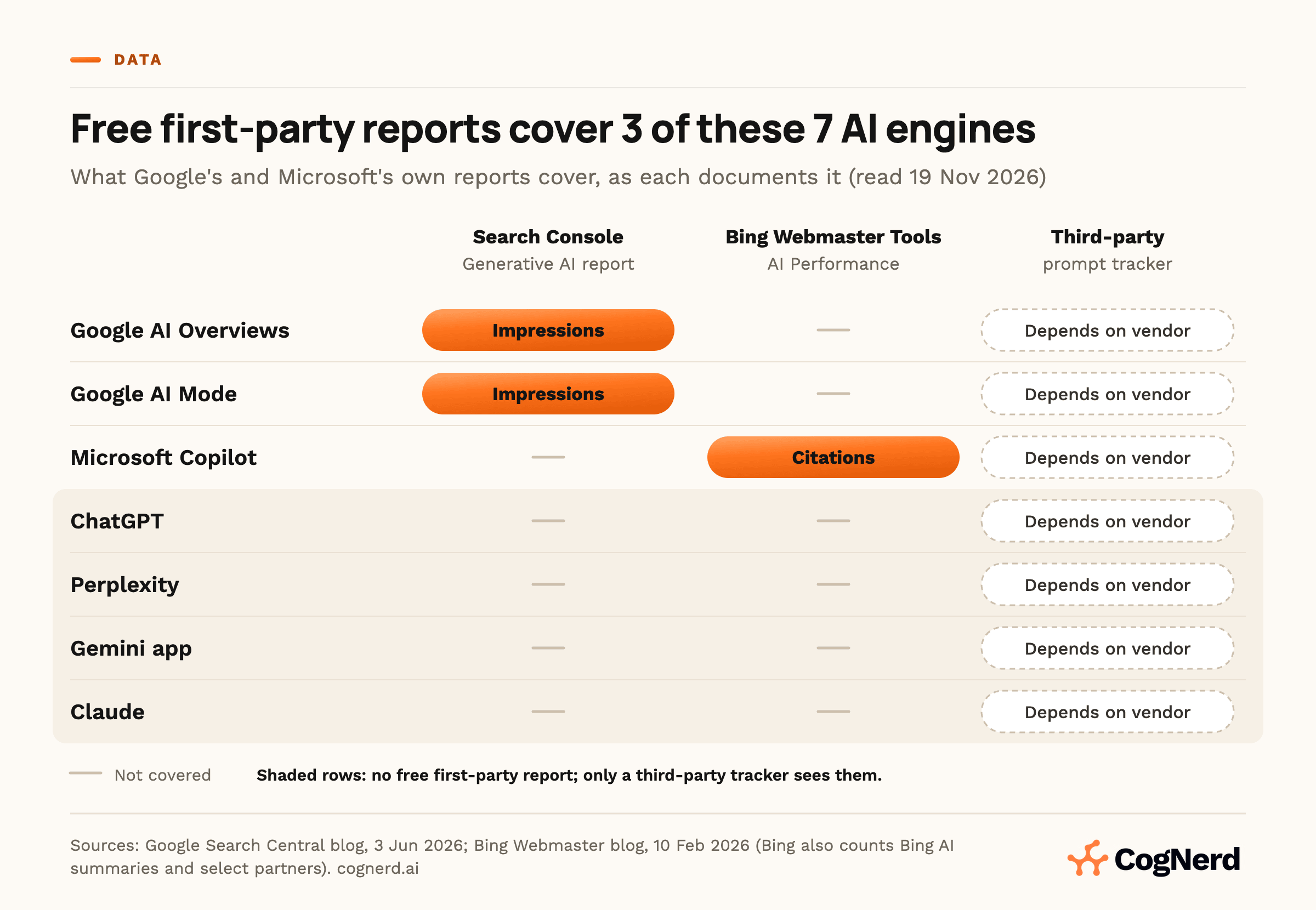
Figure 2. Source: Google Search Central blog, 3 Jun 2026; Bing Webmaster blog, 10 Feb 2026. Bing's count also includes partners it does not name.
What do the best GEO tracking tools claim to do?
Profound, Peec AI, AthenaHQ, Otterly and CogNerd all claim to monitor AI answers and trace sources (jobs 3 and 4). The rows paraphrase each homepage as read on 19 Nov 2026, untested; CogNerd sells a tool here, so read our row with the same care.
For ranked lists, see best AEO tools and best AI SEO tools.
| GEO tool What the vendor says (homepage, 19 Nov 2026) Jobs it claims (of the 6) |
| Profound | Answer Engine Insights, Prompt Volumes, Shopping, Agent Analytics ("how bots view, cite, and refer to your pages"), Agents | 1, 3, 4 |
| Peec AI | Runs each prompt once every 24 hours on each selected model; tracks sources "used" and "cited"; Looker Studio, API, MCP | 3, 4 |
| AthenaHQ | All plans: ChatGPT, Perplexity, Gemini, Google AI Overviews, Copilot; paid plans add AI Mode, Claude, Grok, DeepSeek, Meta AI; content gap analysis | 3, 4, 5 |
| Otterly | Tracks ChatGPT, Gemini, Perplexity, Copilot, Claude, AI Overviews, AI Mode; crawlability checks; content briefs | 1, 3, 4, 5 |
| CogNerd | 5+ AI engines; up to 40 prompts per scan; AI readiness audit; GEO assets; MCP; Search Console and GA4 | 3, 4, 5, 6 |
Two questions separate these tools more than any feature list: which engines does it query, and can you open the raw answer behind each number?
From our scans: how do you measure generative engine optimization?
Measure generative engine optimization by the unbranded mention rate first. On 12 Aug 2026 CogNerd scanned cognerd.ai across six engines (ChatGPT, Claude, Gemini, Perplexity, Grok, DeepSeek), 40 questions each, 240 answers (run ecbf43a5). The same run reads 27%, 20%, 5.8% or 0%, depending on which headline number the tool shows.
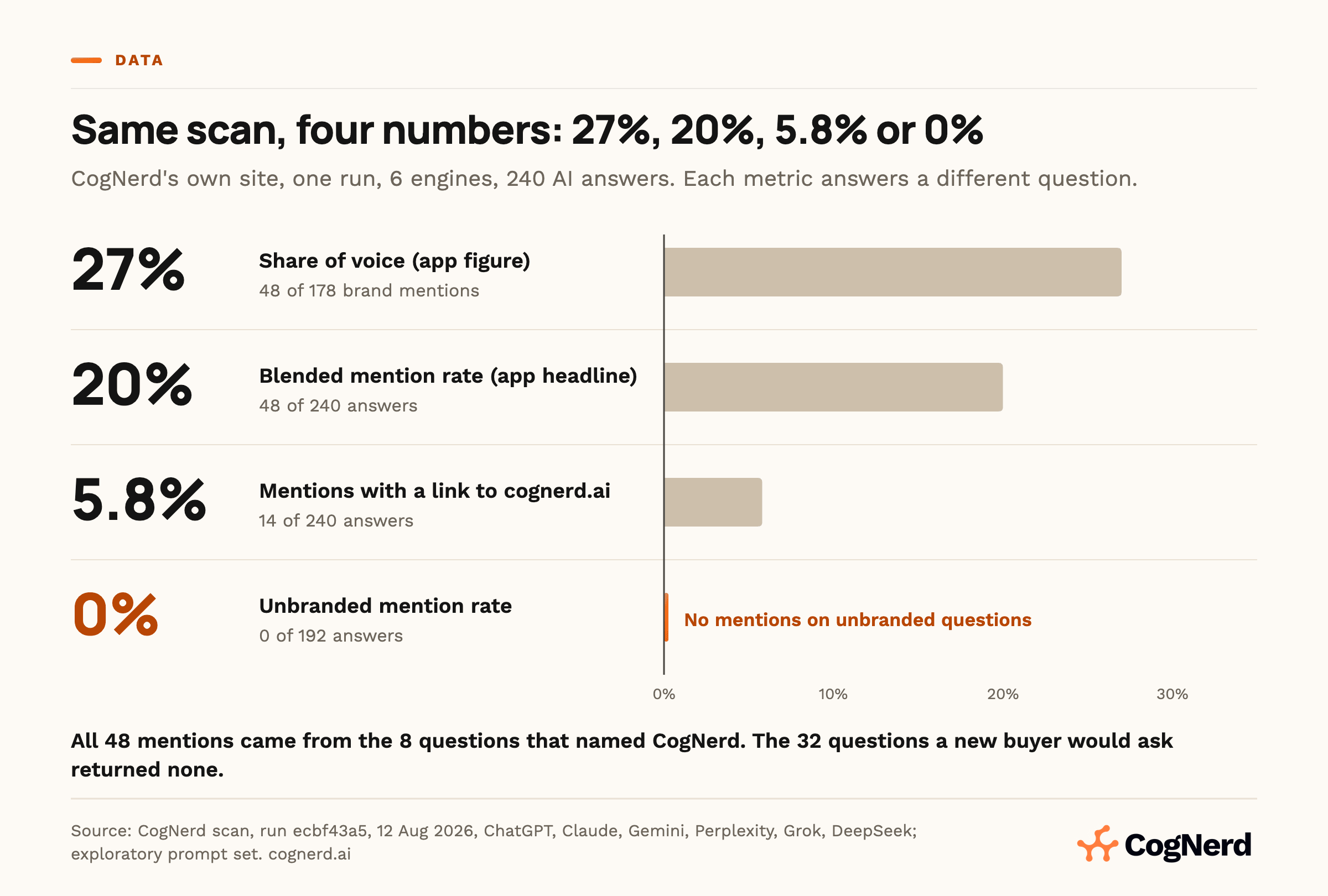
Figure 3. Source: CogNerd scan, run ecbf43a5, 12 Aug 2026, 6 engines, 240 answers. Exploratory prompt set.
| Metric (run ecbf43a5, 12 Aug 2026) Value (count of base) What it counts |
| Share of voice (app figure) | 27.0% (48 of 178) | Our mentions as a share of all brand mentions in the answers |
| Blended mention rate (app headline) | 20.0% (48 of 240) | Answers that named CogNerd, any question |
| Mentions with a link | 5.8% (14 of 240) | Answers that named CogNerd and linked to cognerd.ai |
| Unbranded mention rate | 0% (0 of 192) | Answers to the 32 questions that did not name CogNerd |
All 48 mentions came from the 8 questions that named us, such as "CogNerd vs X". The 0% is what tells you whether AI recommends you to strangers, so ask any tool you trial for it separately. How to measure AEO lists the other metrics worth tracking.
Want your unbranded rate, not a blended one? Send us your buyers' questions and we will report it apart from the branded rate.
How do you track AI search visibility in one week?
Track AI search visibility in one week by starting free: crawler access on day 1, Search Console and Bing Webmaster Tools on day 2, Bing's Opportunity Queries on day 3 and 20 buyer questions on day 4. A paid tracker comes in on day 5.
- Day 1: crawler check. Allow OAI-SearchBot, PerplexityBot and other AI agents in robots.txt and your CDN; find their visits in logs.
- Day 2: engine reports. Verify the site in Search Console and Bing Webmaster Tools; note pages with AI Overview impressions or Copilot citations.
- Day 3: gap list. If Bing shows Topics Portfolio for your site, export the Opportunity Queries: a content brief written by the engine.
- Day 4: question set. Write 20 buyer questions. At least 15 must not name your brand.
- Day 5: tracker trial. Load them into one or two trackers. Ask each for blended, branded and unbranded rates, and check three answers by hand.
- Day 6: traffic baseline. Build a GA4 exploration for AI referrers.
- Day 7: fix list. Fix the three pages that appear in AI reports but lose to a competitor.
Is CogNerd a generative engine optimization tool?
Yes. CogNerd is a GEO tool that covers jobs three to six: your question set across 5+ AI engines, branded and unbranded results reported apart, the sources behind each answer, and gaps turned into content briefs. We also run AEO and GEO services if you would rather hand the work over.
Set up the free tools first, then get your free AI visibility audit to see where your brand stands across AI engines today.
About the author. Aman Mundra is Founder & CEO of CogNerd, an Indian AI search visibility company based in Chandigarh. He spent about ten years as a machine learning engineer, including at PayPal, before building CogNerd to measure how brands appear in AI answers.
Last updated: 20 Nov 2026. CogNerd sells an AI visibility platform and AEO/GEO services.
Sources
All read 19 Nov 2026.
- Microsoft Bing, "Introducing Topics Portfolio (Beta) in AI Performance", Bing Webmaster blog, 13 Oct 2026. https://blogs.bing.com/webmaster/2026/10/introducing-topics-portfolio-beta-in-ai-performance
- Microsoft Bing, "Introducing AI Performance in Bing Webmaster Tools Public Preview", 10 Feb 2026. https://blogs.bing.com/webmaster/2026/2/Introducing-AI-Performance-in-Bing-Webmaster-Tools-Public-Preview
- Google Search Central blog, "Introducing Search Generative AI performance reports in Search Console", 3 Jun 2026. https://developers.google.com/search/blog/2026/06/gen-ai-performance-reports
- Google Search Central, "Google's Guide to Optimizing for Generative AI Features on Google Search". https://developers.google.com/search/docs/fundamentals/ai-optimization-guide
- OpenAI, "Overview of OpenAI crawlers". https://developers.openai.com/api/docs/bots
- Vendor homepages: tryprofound.com, peec.ai, athenahq.ai, otterly.ai, cognerd.ai
- CogNerd scan, run ecbf43a5, 12 Aug 2026, 6 engines, 240 answers (internal ledger)
FAQ
Related articles

FAQ
Quick answers on CogNerd, AI search optimization, AEO, GEO and SEO.
See how AI search sees your brand.
Run a free AI visibility scan and see exactly where your brand stands today against your top 3 competitors, engine by engine.
Visibility report
Visibility score
61.4baseline
Engines citing you
2 / 5
Top gap“best {your category} platform”