An AI visibility tracker is a tool or process that asks engines such as ChatGPT, Gemini and Perplexity the same buyer questions on a schedule and records whether your brand is mentioned, cited and described correctly. The value is the series: same questions, engines and method, so runs compare.
Back to all blogs Last updated: 11.21.2026
What should an AI visibility tracker track week to week?
CN
By CogNerd TeamAn AI visibility tracker logs how AI engines mention your brand each week. In 13 of our runs, mentions held at 18.3% to 20.3% as the score swung 19.2 to 29.9.
Key Takeaways
- Headline the unbranded mention rate. Across 13 runs on our brand, mentions stayed at 18.3% to 20.3% while the composite score swung from 19.2 to 29.9.
- Run weekly, decide monthly. The IAB calls monthly measurement typically sufficient for trend monitoring.
- At 240 answers a run and a 20% mention rate, a move under about 7 points can be chance.
- Google's November 2026 core update began on 10 Nov 2026. Start a new series there.
An AI visibility tracker should ask the same fixed buyer questions every week and record whether the run completed, your unbranded and branded mention rates, citations to your own site, which rivals and sources the engines used, and what changed. Read it monthly. A move smaller than run-to-run noise is no change.
Why is AI visibility tracking important?
AI visibility tracking matters because one reading tells you little. Two runs of our own tracker on the same day, 17 Jul 2026, scored 19.2 and 21.9 on the app's composite index. Only a fixed weekly series shows whether a move is real.
The engines keep moving under any baseline. On 10 Nov 2026 Google released the November 2026 core update globally, in all languages, with a rollout of up to two weeks. Google says AI Overviews and AI Mode follow the same Search eligibility rules and SEO basics as regular results (Google Search Central), so their sources can move with it.
Few brands track this at all: the IAB's Measuring Visibility in the AI Era framework (August 2026) says only 16% do it systematically. The rules below follow that framework.
An AI visibility audit tells you where you stand once. A tracker tells you whether your work moves it. New to the term? Read what AI search visibility is.
What should an AI visibility tracker log in every run?
An AI visibility tracker should log the same eight fields every run: run status, unbranded and branded mention rates, own-site citation rate, rivals named, sources used, wrong facts and a change log. Headline the unbranded mention rate. Identical fields let any two weeks line up row by row.
| Field to log each run What to record Why it matters |
| Run status | Answers received vs expected, date, engines, country | A partial or empty run looks like a drop if you do not check |
| Unbranded mention rate | Share of answers to questions that do not name you, that do mention you | The only number that shows new buyers finding you |
| Branded mention rate | Same, for questions that name you | A sanity check that engines know you; it should sit near 100% |
| Own-site citation rate | Share of answers that link a page on your domain | Shows the engine uses your pages, not just your name |
| Rivals named | Which competitors appear on your unbranded questions, and how often | Tells you who holds the answer you want |
| Sources used | The third-party sites the engines cite for those questions | Your outreach and PR list for next month |
| Wrong facts | Any incorrect claim about you, with the answer text | A wrong mention can cost more than no mention |
| Change log | What you shipped and any platform event (model release, new answer layout) | The only way to explain a move later |
Two rules keep the log usable:
- Freeze the question set. Write at least 50 questions and leave them alone for the quarter. The IAB treats fewer than 50 as exploratory. Edit the questions and the series breaks.
- Keep the raw answers. A percentage says something moved. The answer text says what, and which source the engine leaned on.
The metrics are defined in how to measure AEO. Free and first-party: Google's Search Console generative AI performance report, live for all sites since 31 Aug 2026, shows AI Overviews and AI Mode impressions by page, country and device (see Search Console's AI Overview reporting).
How often should you track AI visibility?
Track AI visibility weekly and decide monthly. The IAB's Measuring Visibility in the AI Era framework (August 2026) calls monthly measurement typically sufficient for trend monitoring and warns that measuring weekly for a decision made quarterly "produces data more volatile than useful". Weekly runs still catch failed scans and platform events within days.
| Decision the tracker feeds IAB cadence (August 2026) What CogNerd does |
| Trend monitoring, early warning | Monthly is typically sufficient | Run weekly, report a four-week view |
| Competitive benchmarking, agency reporting | Biweekly to weekly | Weekly runs, compare four-week blocks |
| Budget allocation, choosing a provider | Weekly or more, decision-grade sample | Repeat each question several times per run before deciding |
| After a model release or a big site change | Re-baseline straight away | Fresh run the same week, new series from that date |
The monthly read, across four runs, is where you decide. Before you set the schedule, note which row your next budget or content decision falls in.
How accurate is AI visibility tracking week to week?
At a 20% mention rate and 240 answers a run, an AI visibility tracker can show moves under about 7 points from chance alone. A January 2026 study with Gumshoe by SparkToro found under a 1 in 100 chance that ChatGPT or Google's AI gives the same brand list in any two of 100 responses to one prompt.
The odds of the same order were under 1 in 1,000. Rand Fishkin's conclusion: how often a brand appears across many runs is probably a reasonable measure. Its rank is not.
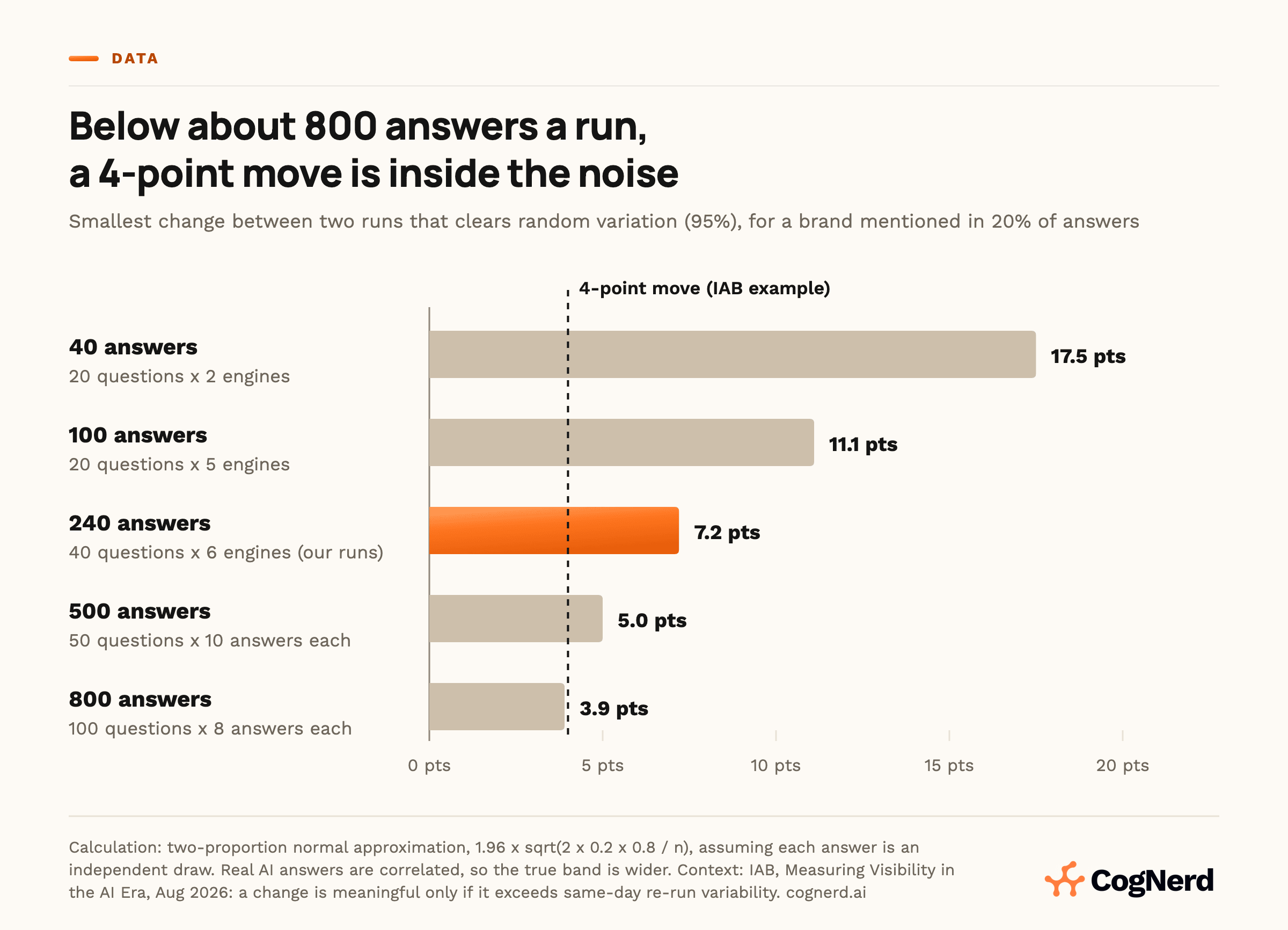
Calculation: two-proportion normal approximation at 95%, 1.96 x sqrt(2 x 0.2 x 0.8 / n), independent answers assumed; real answers correlate, so the true band is wider. Context: IAB, August 2026.
The IAB says a four-point move in share of voice counts only if it beats a same-day re-run of the same queries. At 20%, that takes about 800 answers a run. A 100-answer check needs a move of about 11 points. To find your own band, run the same set twice on one day and note the gap.
What did 13 runs of our own AI visibility tracker show?
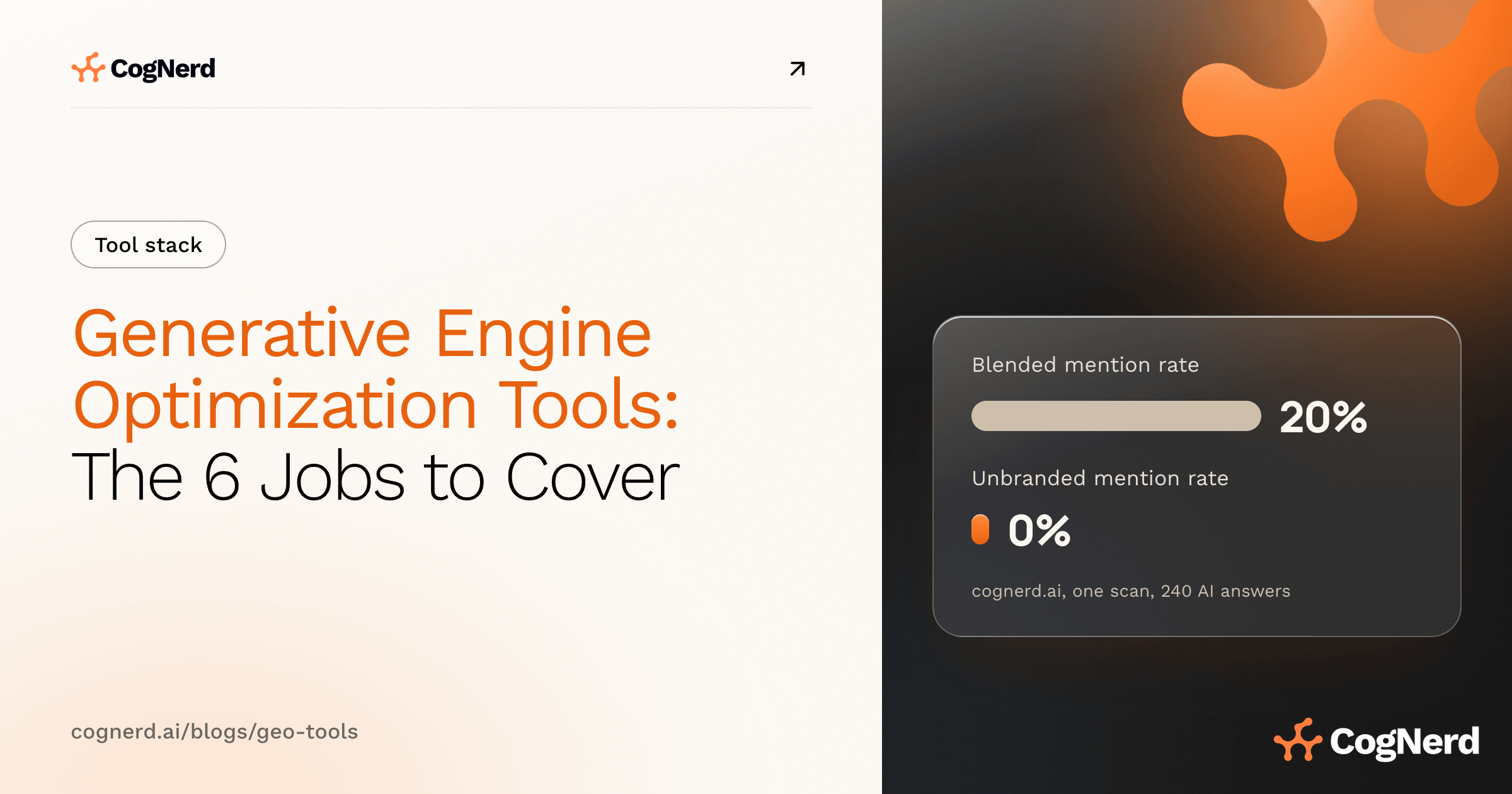
CogNerd tracked cognerd.ai in its own app across 13 completed runs from 9 Apr to 12 Aug 2026: 40 questions on 6 engines (ChatGPT, Claude, Gemini, Perplexity, Grok and DeepSeek). Mentions held at 18.3% to 20.3% while the composite score swung from 19.2 to 29.9. All 13 runs are labeled exploratory.
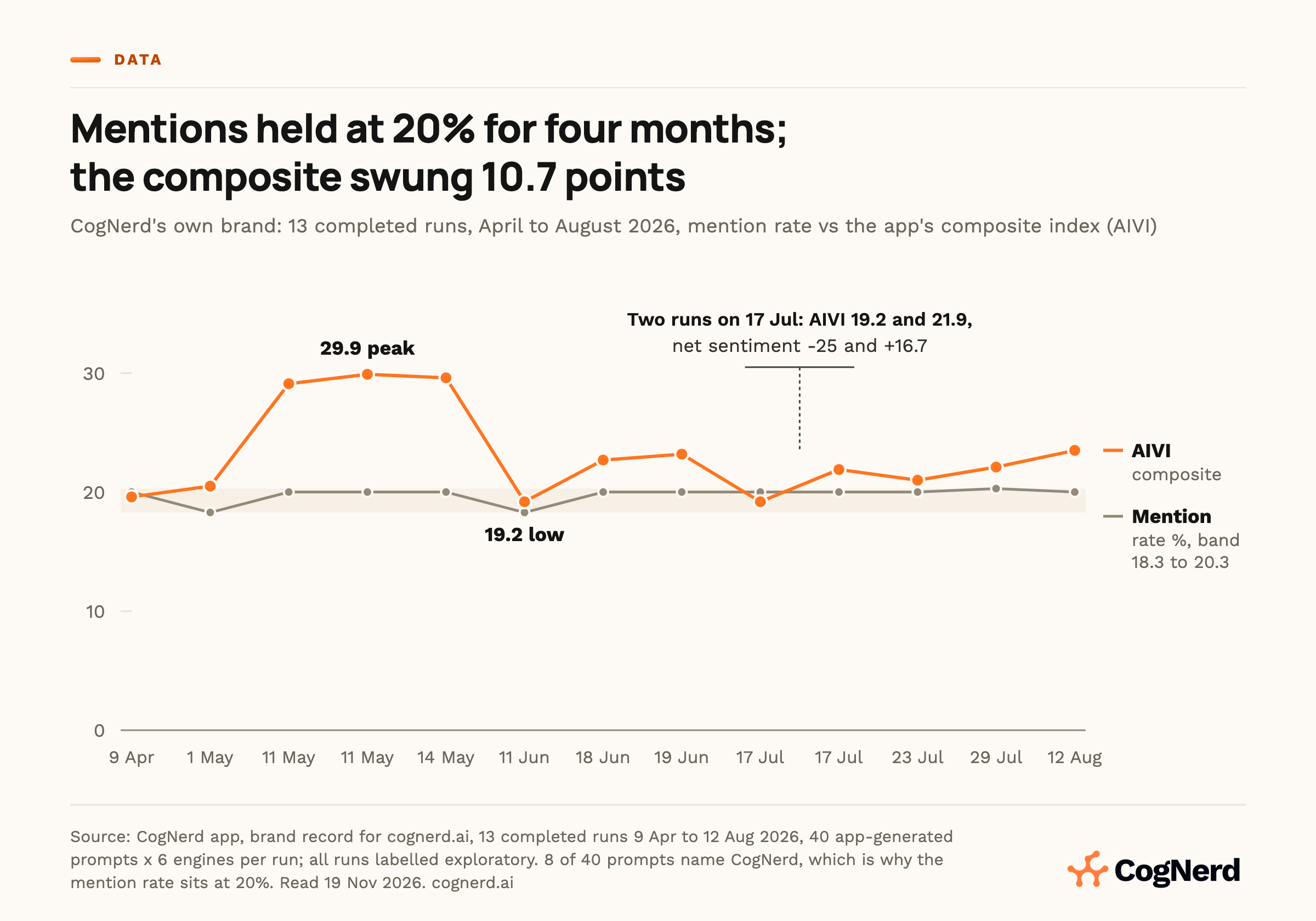
Source: CogNerd app, cognerd.ai brand record, 13 completed runs, 9 Apr to 12 Aug 2026, 40 app-generated questions x 6 engines, read 19 Nov 2026, all exploratory.
- A flat line can be a structural artifact. The rate held near 20% for four months because of the question set: 8 of the 40 questions named CogNerd, and in the latest run every mention came from those eight. Our GEO tools guide breaks that run down four ways.
- Composite scores swing on their own. The composite fell from 29.9 to 19.2 between May and June. Two runs on 17 Jul scored 19.2 and 21.9, with net sentiment of -25 and +16.7.
- Empty runs happen. The brand record holds 31 runs, 13 completed. Scans on 25 Sep and 5 Oct 2026 recorded zero responses. Plotted as zeros, they would look like a collapse.
Limits: one brand, app-generated questions, one answer per question per engine. It is a lesson in reading a tracker. We now report branded and unbranded questions apart, with the run id beside every number.
To start your own series from a clean baseline, ask us for your unbranded mention rate and log it as run one.
How do you know if an AI visibility change is real?
An AI visibility change is real only if it passes four checks in order: the run completed, the method and engines stayed the same, the move beats the noise band, and an unbranded gain holds for a second run. A move during the rollout of Google's core update from 10 Nov 2026 starts a new series instead.
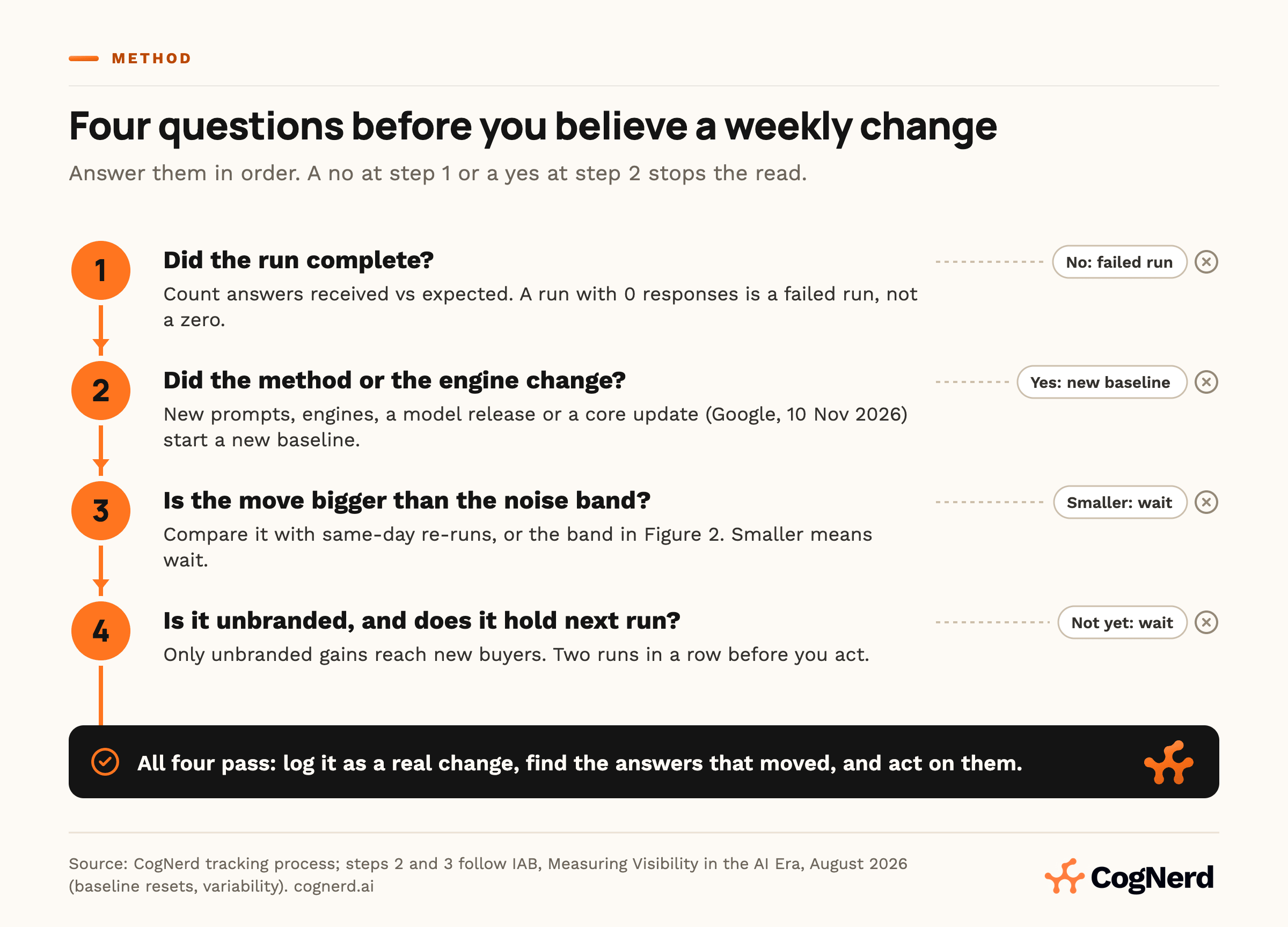
Source: CogNerd tracking process; steps 2 and 3 follow the IAB framework, August 2026.
- Did the run complete? Answers received vs expected. Leave partial runs out of the trend.
- Did the method or the engine change? New questions, engines, countries, a model release or a core update start a new series. The IAB wants pre- and post-reset data kept separate.
- Is the move bigger than the noise band? If it is smaller than your same-day re-run gap, write "no change" and wait.
- Is it unbranded, and does it hold? Only an unbranded gain that survives a second run means new buyers can find you.
Then open the answers that moved: which source the engine started or stopped citing, which rival took the slot. That names the fix: fresher pages (content freshness), mentions on sources engines trust (how to get your brand mentioned in AI search), or a corrected fact. Our 2026 AI visibility report shows how engines shifted from January to July.
Do you need an AI visibility tracker tool, or will a spreadsheet do?
A spreadsheet works as an AI visibility tracker for the first month: 20 to 50 questions asked by hand in each engine, logged against the eight fields. It breaks once you need repeated runs, several engines and countries, and stored answers. Then move to a tool whose trend line shows run-to-run variation.
Before you trust that tool, check that it also flags failed runs and starts a new baseline when the model or the question set changes. For the wider buying checks, from engines to raw answers, compare AI visibility tools.
If two tools disagree on the same brand, ask each how it builds its AI visibility score. CogNerd tracks brands across 5+ AI engines, and our team runs AEO and GEO services for brands that want the fixes done.
To see your own starting line, unbranded number first, get your free AI visibility audit.
About the author. Aman Mundra is Founder & CEO of CogNerd. He spent about ten years as a machine learning engineer, including four years at PayPal, before building CogNerd to measure how brands appear in AI answers.
Last updated: 20 Nov 2026
Sources
- IAB, Measuring Visibility in the AI Era, August 2026: https://iab.com/guidelines/measuring-visibility-in-the-ai-era (PDF: https://www.iab.com/wp-content/uploads/2026/07/IAB_Measuring_Visibility_in_the_AI_Era_August_2026-1.pdf)
- Google Search Status Dashboard, "November 2026 core update", 10 Nov 2026: https://status.search.google.com/incidents/WLxcJyC6jMWMfryxsKMc
- Google Search Central, "AI features and your website": https://developers.google.com/search/docs/appearance/ai-features
- Google (Robby Stein), Gemini 4 Hydrogen in Search, 12 Nov 2026: https://blog.google/products-and-platforms/products/search/gemini-4-hydrogen-search-upgrade
- Google Search Central, Search Console generative AI reports, 3 Jun 2026: https://developers.google.com/search/blog/2026/06/gen-ai-performance-reports
- SparkToro and Gumshoe, January 2026: https://sparktoro.com/blog/new-research-ais-are-highly-inconsistent-when-recommending-brands-or-products-marketers-should-take-care-when-tracking-ai-visibility/
- CogNerd app: 13 completed runs on cognerd.ai, 9 Apr to 12 Aug 2026 (latest ecbf43a5), exploratory
All web sources read 19 Nov 2026. Disclosure: CogNerd sells an AI visibility platform and AEO/GEO services.
FAQ
Related articles

FAQ
Quick answers on CogNerd, AI search optimization, AEO, GEO and SEO.
See how AI search sees your brand.
Run a free AI visibility scan and see exactly where your brand stands today against your top 3 competitors, engine by engine.
Visibility report
Visibility score
61.4baseline
Engines citing you
2 / 5
Top gap“best {your category} platform”