Yes. Semrush sells AI visibility tracking through its AI Visibility Toolkit, so it belongs on a Profound alternatives shortlist. If your team already works in Semrush, trial the toolkit against the same seven checks as any other tool, starting with the branded vs unbranded split.
Back to all blogs Last updated: 11.24.2026
What are the best Profound alternatives, and how do you choose one?
CN
By CogNerd TeamComparing Profound alternatives? Our own app's two reports put one scan at 18.8% and 31.1% share of voice. See why AI visibility tools differ, and 7 checks.
Key Takeaways
- Most "Profound alternatives" lists are written by vendors who rank themselves first.
- AI answers rarely repeat: asked 100 times, ChatGPT or Google's AI has less than a 1 in 100 chance of listing the same brands in any two answers (SparkToro, Jan 2026).
- Before you buy, run the same 10 questions through every tool and check three by hand.
Short answer: The best-known Profound alternatives are Peec AI, AthenaHQ, Scrunch, Semrush's AI Visibility Toolkit, SE Ranking, Otterly and CogNerd. None of them is best for everyone. Pick the tool that measures the engines your buyers use, reports branded and unbranded questions separately, and lets you open the raw AI answer behind every number.
The same CogNerd scan ranked a skincare brand first of 9 brands, yet Perplexity named that brand in 1 of 40 answers. Both numbers were correct. That gap is why a list of Profound alternatives helps less than a way to test them.
Why do teams look for Profound alternatives?
Teams look for Profound alternatives mostly for fit. Profound's Series D release (15 Sep 2026) says it serves over 1,000 enterprise brands and over a third of the Fortune 100, and its homepage leads with an "AI Marketer" for whole marketing teams.
The usual reasons:
- Team size. A one-person team needs fewer seats and faster setup.
- Scope. Measurement only, or content briefs and fixes too.
- Market. A brand selling outside the US, in India for example, wants its own cities and languages covered.
- A second opinion. A number that moves budget deserves one.
Google also says a logging error under-counted Generative AI impressions in Search Console from 9 to 11 Nov 2026. If Google's own AI report can be off for three days, how sure are you of any vendor's?
What are the best Profound alternatives for GEO?
The best-known Profound alternatives for GEO are Peec AI, AthenaHQ, Scrunch, Semrush (AI Visibility Toolkit), SE Ranking (SE Visible), Otterly and CogNerd. The table quotes each vendor's homepage as read on 19 Nov 2026; we have not tested every claim. CogNerd sells a tool in this category, so read our row with the same care.
| AI visibility tool Homepage headline (19 Nov 2026) What the vendor's homepage says it covers Source (read 19 Nov 2026) |
| Profound | "The AI Platform to Power Your Marketing" | An "AI Marketer" that finds gaps in AI answers, rewrites pages, runs social posts and stages sponsored answer ads, across ChatGPT, Perplexity, Gemini, AI Overviews, AI Mode and others | tryprofound.com |
| Peec AI | "AI search analytics for marketing teams" | Visibility, position and sentiment; prompt tracking with suggested prompts and search volumes; cited sources; CSV export, Looker Studio connector, API and MCP | peec.ai |
| AthenaHQ | "See, Act, and Win on AI Search and Beyond" | Tracking across "11+ LLMs", from ChatGPT and AI Overviews to Copilot, Grok and Meta AI; citation sources, content gaps, PR monitoring | athenahq.ai |
| Scrunch | "The AI Customer Experience Platform" | An Agent Experience Platform (AXP) to observe what AI agents say and do, optimize the site for them and serve them what they need | scrunchai.com |
| CogNerd | "See Your Brand. Shape What AI Says." | Visibility tracking across "5+ AI engines, including ChatGPT, Gemini and Google AI Overviews"; up to 40 prompts per scan; weekly rescans; content briefs; MCP; Google Search Console and GA4 sync | cognerd.ai |
Semrush (AI Visibility Toolkit), SE Ranking (SE Visible) and Otterly also sell AI visibility tracking; their product pages were read on 19 Nov 2026. For the wider market, see our best AI SEO tools ranking and best AEO tools shortlist.
Why do AI visibility tools give different numbers?
AI visibility tools give different numbers because the engines keep changing their answers. In SparkToro and Gumshoe's January 2026 study, ChatGPT and Google's AI had less than a 1 in 100 chance of listing the same brands in any two of 100 answers. Two tools sampling on different days, questions and locations will disagree even when both work as designed.
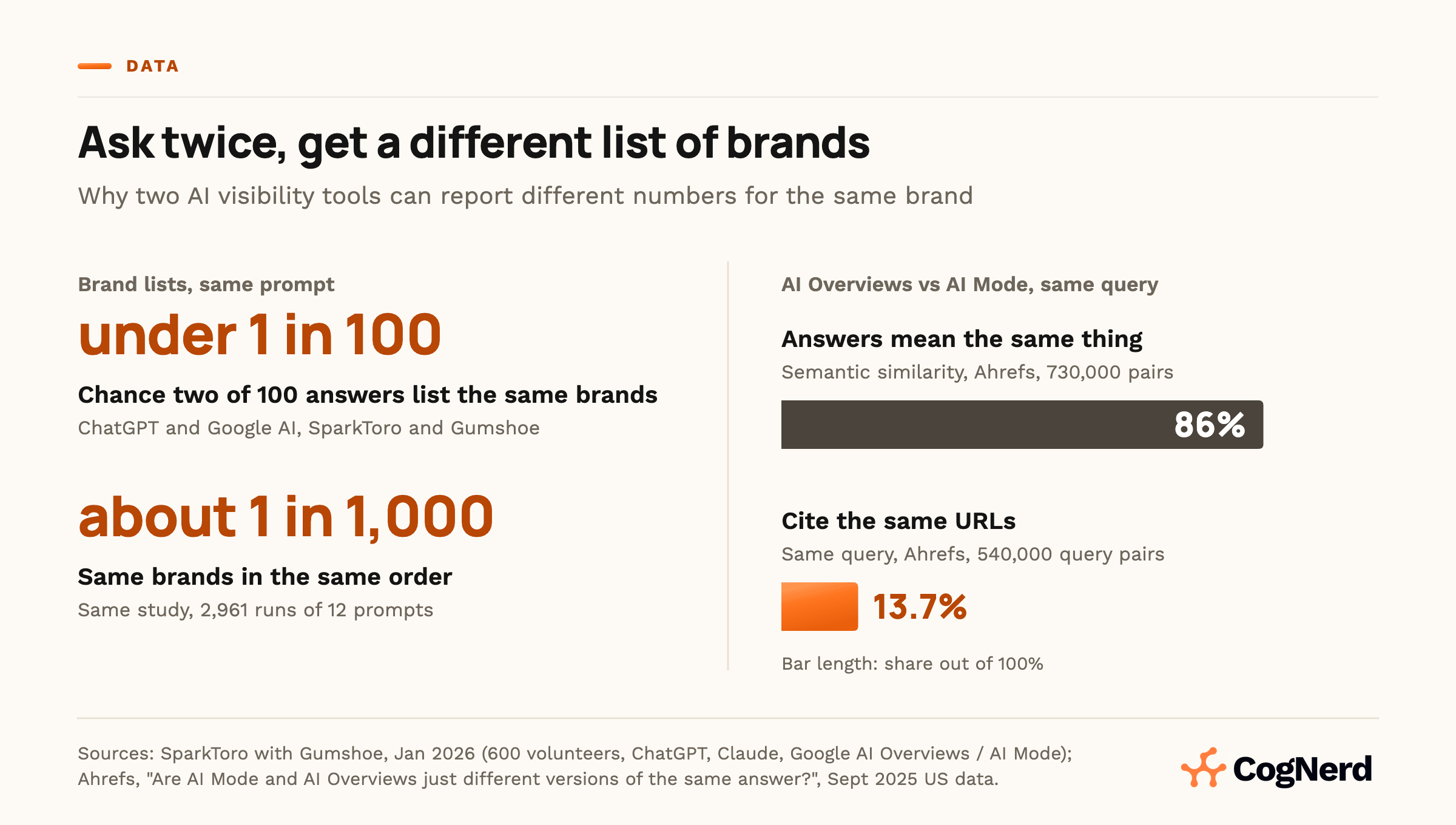
Figure 1. Source: SparkToro with Gumshoe, January 2026 (600 volunteers, 12 prompts, 2,961 runs); Ahrefs, September 2025 US data (540,000 and 730,000 query pairs).
- SparkToro and Gumshoe (January 2026). 600 volunteers ran 12 prompts through ChatGPT, Claude and Google's AI 2,961 times. The same order came up closer to once in 1,000 runs (SparkToro). Rand Fishkin's read: visibility percentage across many runs is probably reasonable; rank inside an answer is close to meaningless. Gumshoe sells AI tracking.
- Ahrefs (September 2025 US data). AI Overviews and AI Mode answers to the same queries were 86% semantically similar, yet shared only 13.7% of cited URLs (Ahrefs). More in AI Mode vs AI Overviews.
So ask every vendor how it samples and whether you can audit it.
How do you choose the best AI visibility tool? 7 checks
Choose the best AI visibility tool for your team by scoring each tool you trial from 0 to 2 on the seven checks below. Given the SparkToro variance, weight raw answers and repeat sampling, the checks that let you audit a number, above dashboard features.
- Engines measured. ChatGPT and Google AI Overviews for most brands, plus Perplexity, Gemini or Claude if your buyers use them.
- Question set control. Can you lock your own buyer questions? If the tool rewrites them monthly, you cannot read a trend.
- Branded vs unbranded split. A question naming your brand nearly always returns it, so a blended number flatters you.
- Raw answers. Can you open the answer text behind every number?
- Citations and sources. Does it show the URLs each engine cited, including competitors, Reddit and review platforms?
- Market and language. Can it run questions for a specific country, city or language? Outside the US, this decides whether the data describes your buyers.
- Repeat sampling. Does it run each question more than once per period? One run tells you almost nothing.
Our guide on how to measure AEO lists the metrics worth tracking once a tool is in place.
Can one AI visibility tool report two different numbers?
Yes. On 23 Oct 2026 one CogNerd scan of a D2C skincare brand (run 72c0b941: 40 questions, ChatGPT and Perplexity, 80 answers; Gemini failed on all 40 calls and is excluded) showed 18.8% share of voice in the visibility report and 31.1% in the competitor report. Neither was wrong; each used a different denominator.
| Run 72c0b941 (23 Oct 2026), read by... Share of voice Headline figure Why it differs |
| The visibility report | 18.8% | Mentioned in 16.3% of answers (13 of 80) | Counts answers that name the brand |
| The competitor report | 31.1% | Visibility 41.3, ranked first of 9 brands | Counts every mention (33 in all) against a different denominator |
| ChatGPT alone (visibility report) | 30.8% | Mentioned in 30.0% of answers | One engine carried the result |
| Perplexity alone (visibility report) | 3.3% | Mentioned in 2.5% of answers | The other engine barely named the brand |
Source: CogNerd app, run 72c0b941, D2C skincare brand, 23 Oct 2026, 40 prompts x ChatGPT and Perplexity, read the same day. Exploratory prompt set.
We now quote one report per brand, with the run id and each engine on its own line.
A blended number can also hide a zero on unbranded questions: across the four brands in our AI visibility audit, unbranded answers named the brand 1.9% of the time (8 of 432). That is check 3 in practice, and why an AI visibility score needs its base printed beside it.
Want your brand's numbers split this way, engine by engine? Ask for a scan that separates branded from unbranded answers.
Which AI visibility checks matter most for a small team?
For a small marketing team, the AI visibility checks that matter most depend on the decision in front of it. A founder who needs proof wants raw answers and a branded vs unbranded split; a team selling in several countries needs market and language settings first.
| Your situation Checks to prioritize (of the 7) Why |
| You need to prove the problem to a founder or client | Raw answers, branded vs unbranded split | A screenshot of a real answer persuades faster than a score |
| You will write the fixes yourself | Citations and sources | Shows which pages and third-party sites the engines trust |
| You sell in more than one country | Market and language settings | US-default questions misread demand elsewhere |
| You report monthly to a client | Locked question sets, exportable history | Trends need the same questions every month |
| You are evaluating several vendors | Repeat sampling, same 10 questions in each trial | The only fair comparison |
Which row is yours? Start your trial there.
How do you check AI visibility across tools in a fair trial?
To check AI visibility across tools fairly, give every tool the same 10 buyer questions in the same week, then verify 3 by hand in ChatGPT, Gemini and Google AI Mode. Run this one-week sequence before committing to any tool, ours included.
- Write 10 buyer questions. At least 7 should leave your brand out: "best CRM for a 20-person sales team" rather than "is [brand] good".
- Load the same 10 into every tool on the same day, with the same country setting.
- Ask each tool for three numbers: blended, branded and unbranded mention rate.
- Check 3 questions by hand, logged out, and save the answers.
- Compare. Where a number differs from what you saw, ask the vendor how it samples: runs per question, location, timing.
- Decide on trust first, features second. A tool that explains its numbers beats a nicer dashboard.
Our AI visibility audit guide covers steps 1 to 4 in depth.
Where does CogNerd fit among Profound alternatives?
CogNerd suits teams that want numbers they can check, with markets outside the US, such as India, in scope. CogNerd runs your own question set across ChatGPT, Gemini, Google AI Overviews and other engines, reports branded and unbranded results separately, shows cited sources and turns gaps into content briefs. It syncs with Search Console and GA4.
Run the fair trial before taking our word for it. New to the category? Start with what AI search visibility is. For a baseline on your own brand, get your free AI visibility audit.
Our guide to LLM SEO explains why engines name some brands and skip others.
About the author. Aman Mundra is Founder & CEO of CogNerd, an Indian AI search visibility company based in Chandigarh. He spent about ten years as a machine learning engineer, including four years at PayPal, before building CogNerd to measure how brands appear in AI answers.
Last updated: 20 Nov 2026. CogNerd sells an AI visibility platform; this comparison quotes each vendor's own homepage and does not rank them.
Sources
- SparkToro (Rand Fishkin) with Gumshoe (Patrick O'Donnell), "AIs are highly inconsistent when recommending brands or products", January 2026. https://sparktoro.com/blog/new-research-ais-are-highly-inconsistent-when-recommending-brands-or-products-marketers-should-take-care-when-tracking-ai-visibility (read 19 Nov 2026)
- Ahrefs (Despina Gavoyannis), "Are AI Mode and AI Overviews just different versions of the same answer?", published 15 Dec 2025, September 2025 US data. https://ahrefs.com/blog/ai-overviews-vs-ai-mode (read 19 Nov 2026)
- Google Search Console Help, "Data anomalies in Search Console", entry for 9 to 11 Nov 2026. https://support.google.com/webmasters/answer/6211453 (read 19 Nov 2026)
- Profound, "Profound Raises $180M Series D at $1.8B Valuation to Build the AI Platform For Marketing Teams", 15 Sep 2026. https://www.tryprofound.com/newsroom/profound-raises-usd180m-series-d-at-usd1-8b-valuation-to-build-the-ai-platform-for-marketing-teams (read 19 Nov 2026)
- Vendor homepages: tryprofound.com, peec.ai, athenahq.ai, scrunchai.com, cognerd.ai; product pages for Semrush AI Visibility Toolkit, SE Ranking AI visibility tracker, otterly.ai (read 19 Nov 2026)
- CogNerd scan, run 72c0b941, D2C skincare brand, 23 Oct 2026 (internal; client named by category)
FAQ
Related articles
FAQ
Quick answers on CogNerd, AI search optimization, AEO, GEO and SEO.
See how AI search sees your brand.
Run a free AI visibility scan and see exactly where your brand stands today against your top 3 competitors, engine by engine.
Visibility report
Visibility score
61.4baseline
Engines citing you
2 / 5
Top gap“best {your category} platform”