A free AI visibility score checker is fine for a first look if it shows its question set, the engines it ran and the date. Before trusting it, check whether it separates branded from unbranded questions. Without that split, a free score can show one answer in five while new buyers never see your brand.
Back to all blogs Last updated: 11.25.2026
What is an AI visibility score, and how is it calculated?
CN
By CogNerd TeamAn AI visibility score sums up how often AI engines mention your brand. See what goes into one, why tools disagree, and the split that exposes a hidden zero.
Key Takeaways
- There is no standard formula: the simplest scores are a plain mention rate, others blend in position, citations and sentiment with weights each vendor picks.
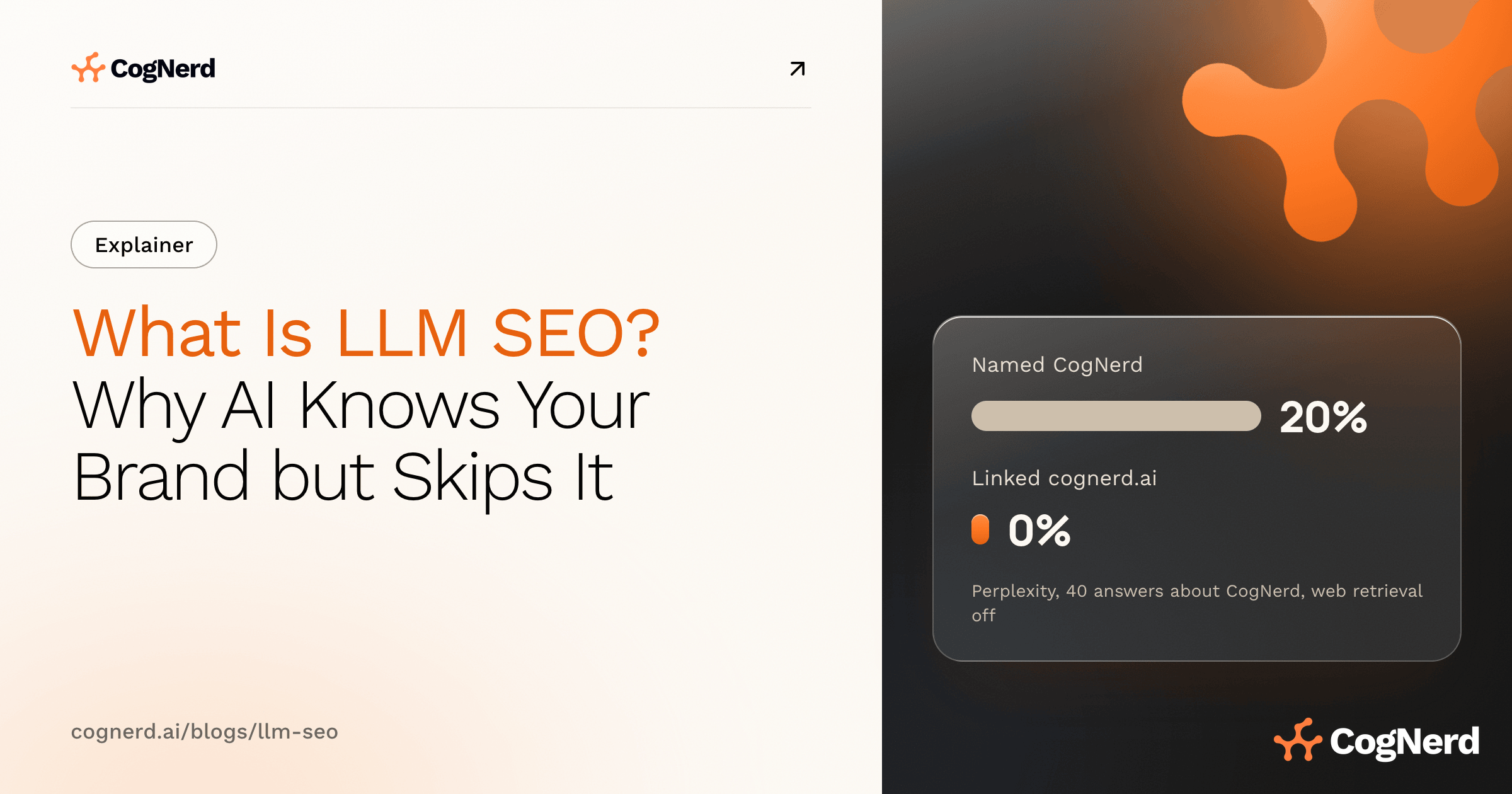
- Split branded from unbranded questions. In three client scans, blended mention rates of 14.5% to 25% sat on top of unbranded rates of 0% to 5.7%.
- Treat position as noise unless it is averaged over many runs: SparkToro found AI engines repeat the same brand list less than 1 time in 100.
An AI visibility score is a single number that sums up how often, how prominently and how accurately AI engines such as ChatGPT, Gemini and Perplexity mention your brand across a fixed set of buyer questions. Most tools count the share of answers that name you; some add position, citations and sentiment on a 0 to 100 scale.
Why is AI visibility important for brands in 2026?
Two of three client brands CogNerd scanned in 2026 scored one in five or better on blended AI mentions and 0% on unbranded questions. AI visibility matters because research now ends in AI answers: Comscore's Q2 2026 data, reported by Search Engine Land, put Google AI Overviews on 39.4% of U.S. desktop searches in June 2026, up from 25.8% in July 2025.
When an AI summary appears, fewer people click. Pew Research Center tracked 900 U.S. adults in March 2025, who clicked a traditional result on 8% of visits to a results page with an AI summary, 15% without one, and a link inside the summary on 1%. A visibility score covers the named-but-not-clicked part of AI search visibility.
Twenty questions across five engines is 100 answers per run. What does the one-line score made from them count?
How is an AI visibility score calculated?
An AI visibility score is calculated from four choices: which buyer questions are asked and how many name the brand, which engines run them in which country and language and how often, which signals each answer is scored on, and how those signals are weighted onto a 0 to 100 scale. Change any one and the score moves.
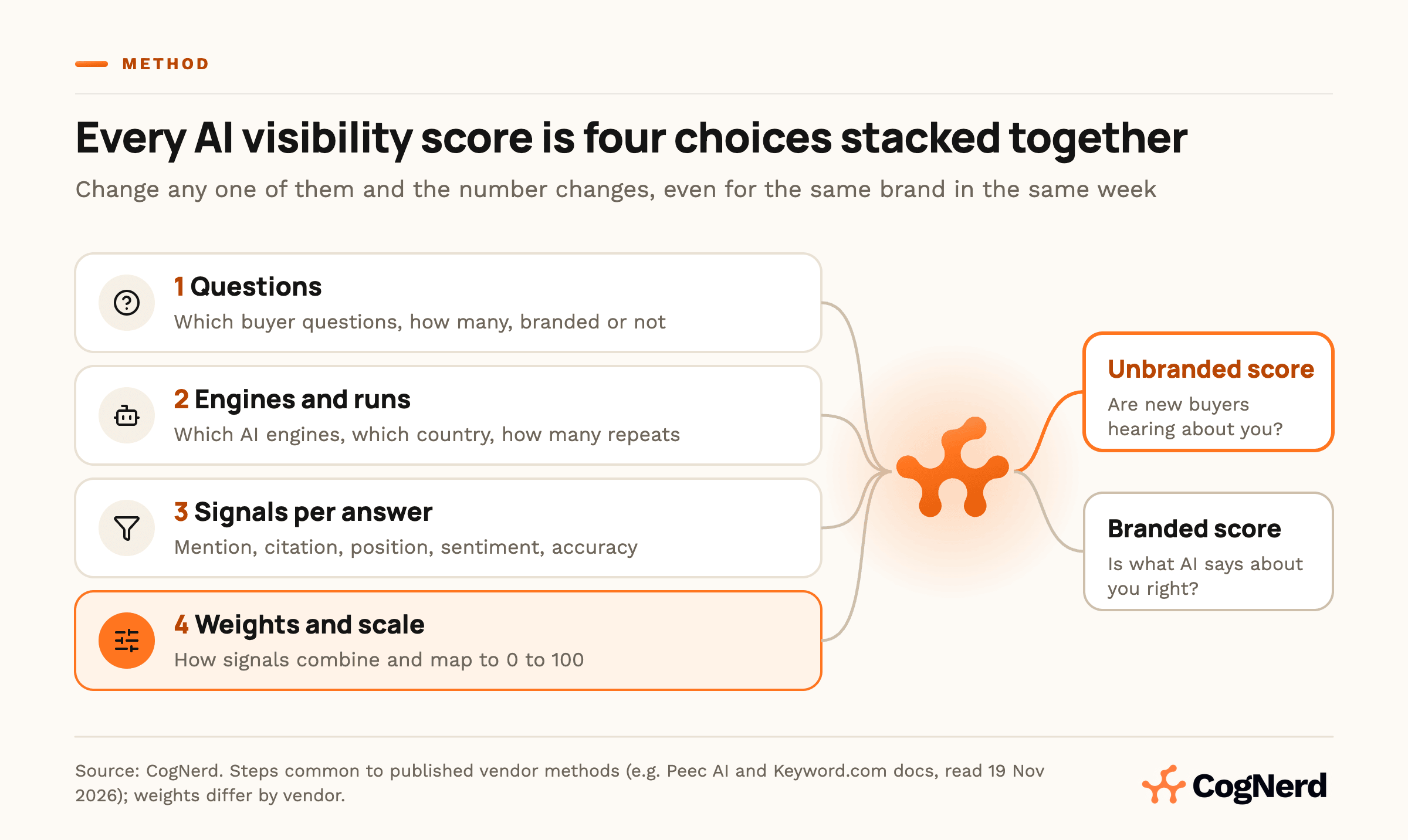
The four choices behind any AI visibility score. Source: CogNerd; steps common to published vendor methods such as the Peec AI and Keyword.com docs (linked below), read 19 Nov 2026.
Published formulas start far apart. Peec AI's documentation divides responses mentioning the brand by total responses, times 100: a pure mention rate. Keyword.com's score out of 100 multiplies how often the brand is detected by a score for how high it ranks. Same name, different number.
What metrics make up an AI visibility score?
Most AI visibility scores combine six metrics: mention rate, position, citation rate, accuracy, sentiment and coverage. Mention rate is the base of published formulas such as Peec AI's, and vendors add the other five with weights they choose. The table defines each metric and the trap to check for.
| AI visibility metric What it measures Why it matters Watch out for |
| Mention rate | Share of answers that name your brand | The basic "are you there" signal | Inflated by questions that name you |
| Position | Whether you are named first, in a list, or in passing | First-named brands get the most attention | Changes almost every run; average it |
| Citation rate | Share of answers that link to your own site | Shows the engine uses your pages as a source | Engines use far more sources than they show |
| Accuracy | Whether facts about you are correct | A wrong mention can cost more than no mention | Needs a human or a fact list to check |
| Sentiment | Whether the tone is positive, neutral or negative | Context for how you are described | Most mentions read as neutral |
| Coverage | How many engines and questions you appear in | One engine carrying the score is fragile | Engine mix differs by tool |
Citation rate needs a caveat: in the same Q2 2026 report, Comscore's lodging analysis separated sites an AI answer used as a source from sites it showed as a cited link, and the gap was wide.
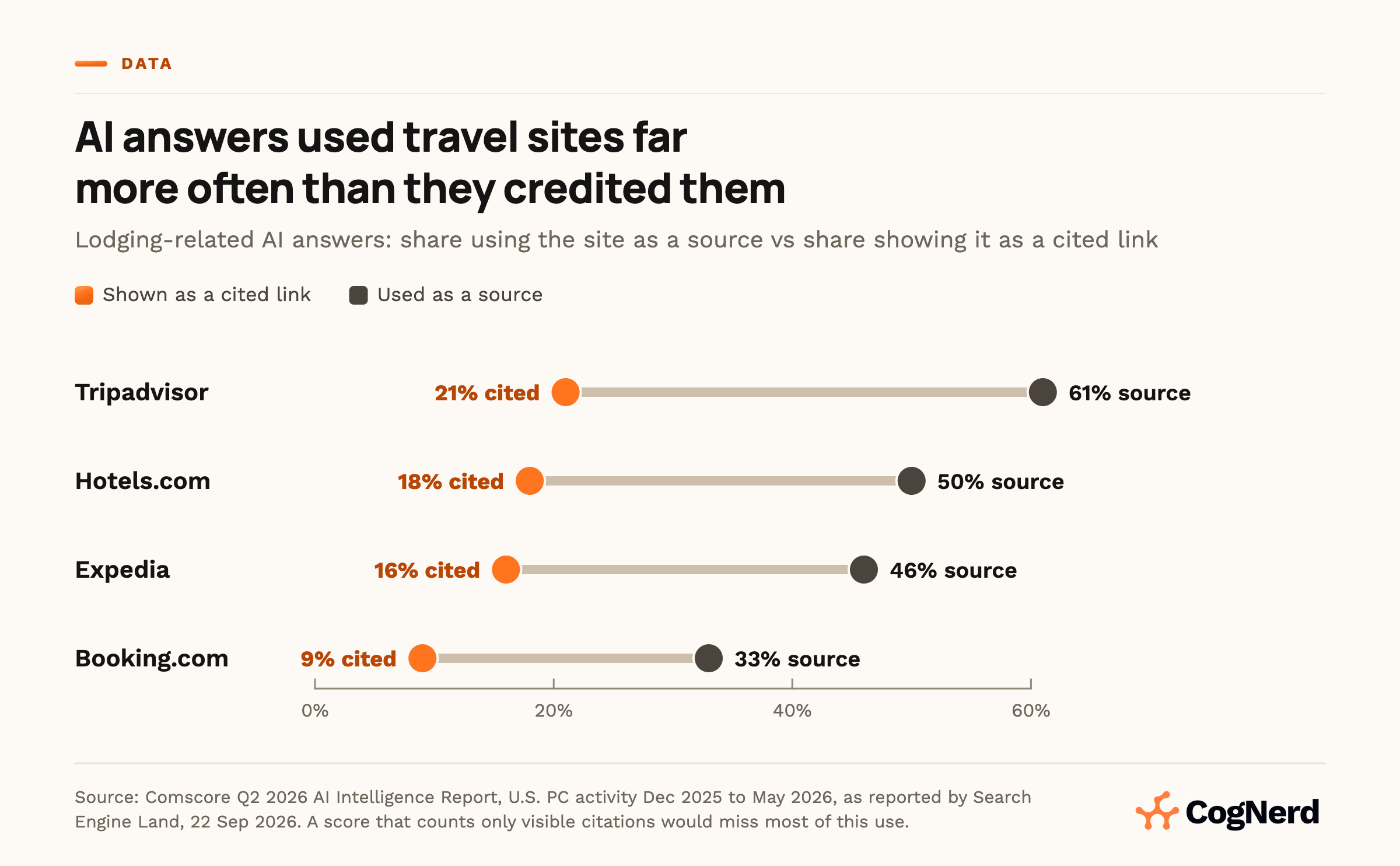
Source: Comscore Q2 2026 AI Intelligence Report, U.S. PC activity December 2025 to May 2026, as reported by Search Engine Land, 22 Sep 2026.
A score counting only visible citations would credit Tripadvisor with about a third of the answers it helped shape, so ask any tool which of the two it counts. For Google's own numbers, see what Search Console's AI Overview reporting does and does not show.
How do you check your AI visibility score yourself?
You can check an AI visibility score yourself with 20 buyer questions, a spreadsheet and an afternoon: score each answer for a brand mention and an own-site citation, then calculate branded and unbranded scores separately. You will know exactly what the score counts.
- Write 20 buyer questions, at least 15 unbranded ("best accounting software for small agencies", not "is BrandX good").
- Run each one in the engines your buyers use, in the same week, logged out.
- Score each answer: 1 point for a brand mention, 1 more for an own-site citation.
- Divide by the maximum possible (2 points times the number of answers) and multiply by 100.
- Calculate it twice: unbranded questions only, then branded only.
- Repeat monthly with the same questions and engines, and keep the answers.
Leave position out of the DIY version. The SparkToro study published in January 2026 found less than a 1 in 100 chance that ChatGPT or Google's AI gives the same list of brands in any two of 100 runs of one question, and about 1 in 1,000 for the same order. Whether you appear holds up across runs. Where you appear does not.
Want your unbranded number before you build the sheet? Ask CogNerd to scan your buyer questions, branded and unbranded counted apart.
What is branded vs unbranded AI visibility?
Branded AI visibility counts answers to questions that name your brand ("Is BrandX good for small teams?"); unbranded AI visibility counts the rest ("What are good tools for small teams?"). Engines almost always mention a brand you ask about, so a few branded questions can lift a blended score while new buyers never hear of you.
From our scans: the hidden zero
We split three client scans, run March to October 2026, by question type.
| Client brand (run id, scan date) Engines queried Blended AI mention rate Branded questions Unbranded questions |
| Wedding caterer (10bb9d17, 27 Oct 2026) | 3 | 20.3% (14/69) | 93% (14/15) | 0% (0/54) |
| School (75426d02, 16 Mar 2026) | 3 | 25.0% (15/60) | 100% (15/15) | 0% (0/45) |
| D2C skincare brand (11f2b9dc, 23 Oct 2026) | 6 (Gemini returned none) | 14.5% (20 of 138 successful answers; 79 calls failed) | 60% (12/20) | 5.7% (8/141) |
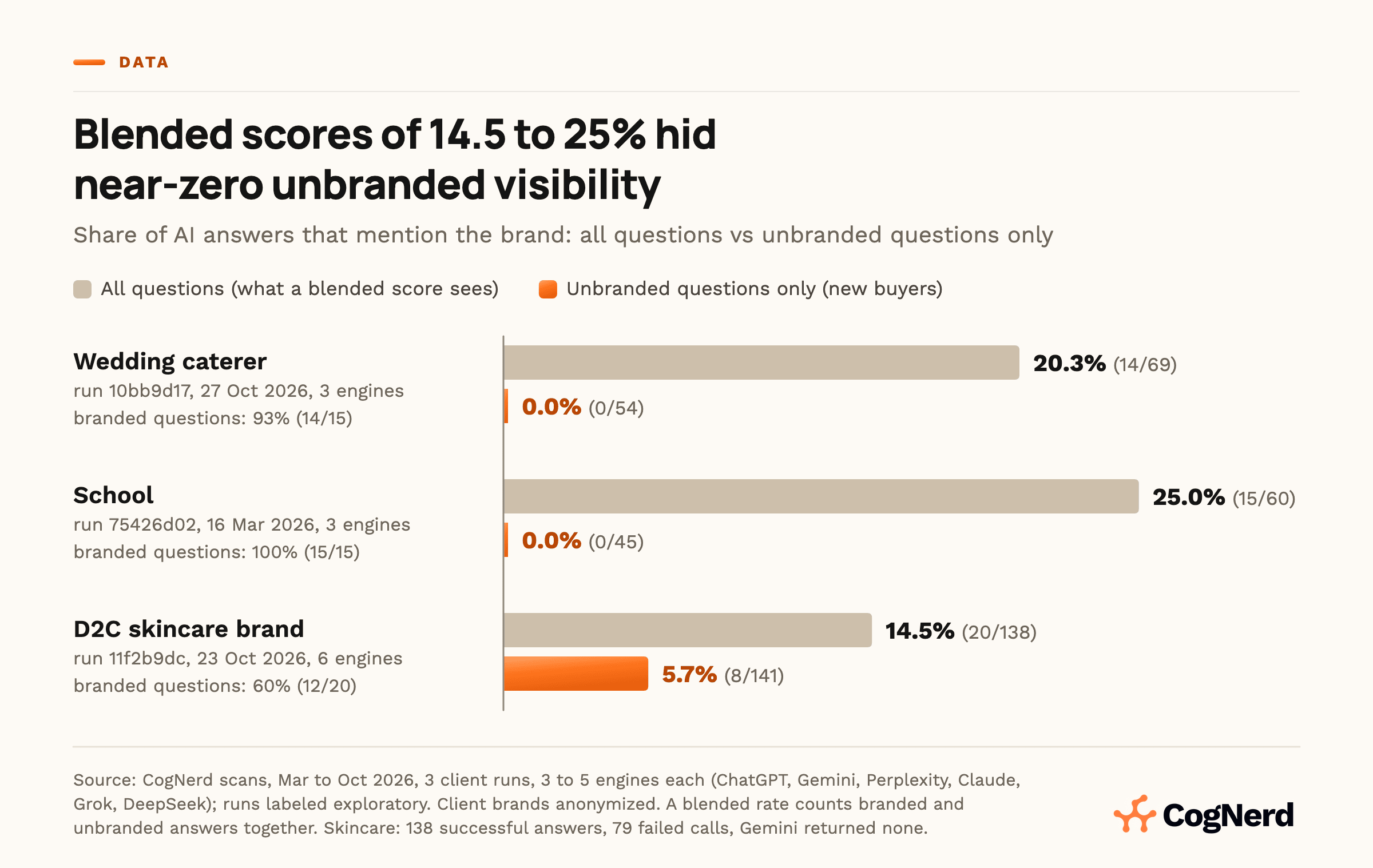
Source: CogNerd scans, March to October 2026, three client runs, 3 to 6 engines each (ChatGPT, Gemini, Perplexity, Claude, Grok, DeepSeek). All runs labeled exploratory; client brands anonymized.
For the caterer and the school, every mention came from a question that already named the brand; on the unbranded questions a new buyer asks, they were absent. The skincare brand scored lowest blended, yet it was the only one a new buyer could find.
Three brands is not a market sample, and each had its own question set: read the table as a pattern to check for, not a benchmark. We now report the unbranded number first for every brand we scan, our own included; the split for cognerd.ai is in how generative engine optimization works.
Why do AI visibility tools give different scores?
AI visibility tools give different scores for the same brand because each makes the four choices its own way: questions, engines, location, timing and formula. Peec AI's pure mention rate and Keyword.com's rank-weighted score will never match, so compare a tool only with itself, month on month.
- Questions. Yours, or the tool's own generator's.
- Engines. One tool may lean on ChatGPT, another on Google AI Overviews.
- Location and language. "Best accounting firm near me" asked from London and from Mumbai gets two different answers.
- Timing. AI answers change between runs, so a weekly sample differs from a monthly one.
Ask each tool for its question set, engines and formula first.
What is a good AI visibility score?
There is no universal benchmark for a good AI visibility score, because every tool uses different questions, engines and weights. A good score is one that rises month after month on your unbranded questions. In CogNerd's 2026 scans, brands with a blended score near 20% still had 0% unbranded visibility, so read the split before the headline.
- Check the base: how many questions, which engines, which dates, branded or unbranded.
- Watch the trend, not the level. A 34 that was 22 last month means more than a 60 that has not moved.
- Open the misses. Where you are absent on unbranded questions, who appears, and from which sources?
- Fix wrong facts at the source, then measure again.
- Turn the gaps into work. The weakest unbranded questions become next month's pages and outreach; how to get your brand mentioned in AI search covers what tends to move them.
For more metrics around the score, how to measure AEO lists ten, and our 2026 AI visibility report shows what changed across engines in the first half of the year. For the crawl, content and source checks behind a score, run an AI visibility audit.
What is a GEO score, and how does CogNerd calculate it?
A GEO score is a generative engine optimization score. CogNerd's GEO Score runs from 0 to 100 for each brand, built from how the brand appears across AI engines on its question set, split by branded and unbranded questions and labeled with its run id. The score always sits next to the answers that produced it, so you can see why it moved.
To see where your brand starts, including your unbranded number, get your free AI visibility audit. Still picking a tool? Our guide to Profound alternatives has seven checks to run first.
About the author. Aman Mundra is Founder & CEO of CogNerd. He spent about ten years as a machine learning engineer, including four years at PayPal, before building CogNerd to measure how brands appear in AI answers.
Last updated: 20 Nov 2026
Sources
- Comscore, Q2 2026 AI Intelligence Report, as reported by Search Engine Land, 22 Sep 2026: https://searchengineland.com/google-ai-overviews-share-us-comscore-490381 (report: https://www.comscore.com/esl/Prensa-y-Eventos/Presentaciones-y-libros-blancos/2026/Q2-AI-Intelligence-Report-2026)
- SparkToro and Gumshoe.ai, "AIs are highly inconsistent when recommending brands or products", January 2026: https://sparktoro.com/blog/new-research-ais-are-highly-inconsistent-when-recommending-brands-or-products-marketers-should-take-care-when-tracking-ai-visibility/
- Pew Research Center, "Google users are less likely to click on links when an AI summary appears in the results", 22 Jul 2025: https://www.pewresearch.org/short-reads/2025/07/22/google-users-are-less-likely-to-click-on-links-when-an-ai-summary-appears-in-the-results/
- Peec AI docs, Visibility metric, read 19 Nov 2026: https://docs.peec.ai/metrics/brand-metrics/visibility
- Keyword.com, AI visibility metrics explained, read 19 Nov 2026: https://intercom.help/keyword/en/articles/13889350-ai-visibility-metrics-explained-formulas-interpretation
- CogNerd scans: client runs 10bb9d17, 75426d02, 11f2b9dc (March to October 2026, exploratory)
Disclosure: CogNerd sells an AI visibility platform. Peec AI and Keyword.com are named only to show how published formulas differ.
FAQ
Related articles
FAQ
Quick answers on CogNerd, AI search optimization, AEO, GEO and SEO.
See how AI search sees your brand.
Run a free AI visibility scan and see exactly where your brand stands today against your top 3 competitors, engine by engine.
Visibility report
Visibility score
61.4baseline
Engines citing you
2 / 5
Top gap“best {your category} platform”