AEO services should re-run the same questions on the same engines every month and ask each question more than once per engine. SparkToro's January 2026 study put the chance of ChatGPT or Google's AI returning the same brand list twice at under 1 in 100, so a single run misleads.
Back to all blogs Last updated: 11.22.2026
What do AEO services include, and when should you see results?
CN
By CogNerd TeamAEO services should give you a dated baseline in month one, fixes by month three, then a monthly re-run. One audit found a sale line posing as the brand's name.
Key Takeaways
- AEO services have four parts: measurement, technical access, answer content and off-site sources. Measurement comes first; it checks the other three.
- Month one ends with a re-runnable baseline: fixed questions, named engines, dates, branded and unbranded results apart.
- Crawler fixes show within days; answers from a model's memory move only when the model is updated.
Short answer: AEO services get your brand named, cited and described correctly in AI answers from ChatGPT, Gemini, Perplexity and Google AI Mode. A sound engagement delivers a dated baseline in month one, technical fixes and new answer pages in months two and three, then the same questions re-run monthly, so you see what moved and why.
In one client's first AEO baseline, 12 of the 23 buyer questions named cities the business does not serve. No new page would have fixed that; a person reading the question set did.
New to answer engine optimization? Start with what AEO is.
What are AEO services and what do they include?
AEO services are four jobs run as a monthly loop: measuring AI answers to buyer questions, fixing AI crawler access, writing answer pages where you are missing, and correcting off-site sources. A sound AEO services proposal names all four, who does each, and how each is measured.
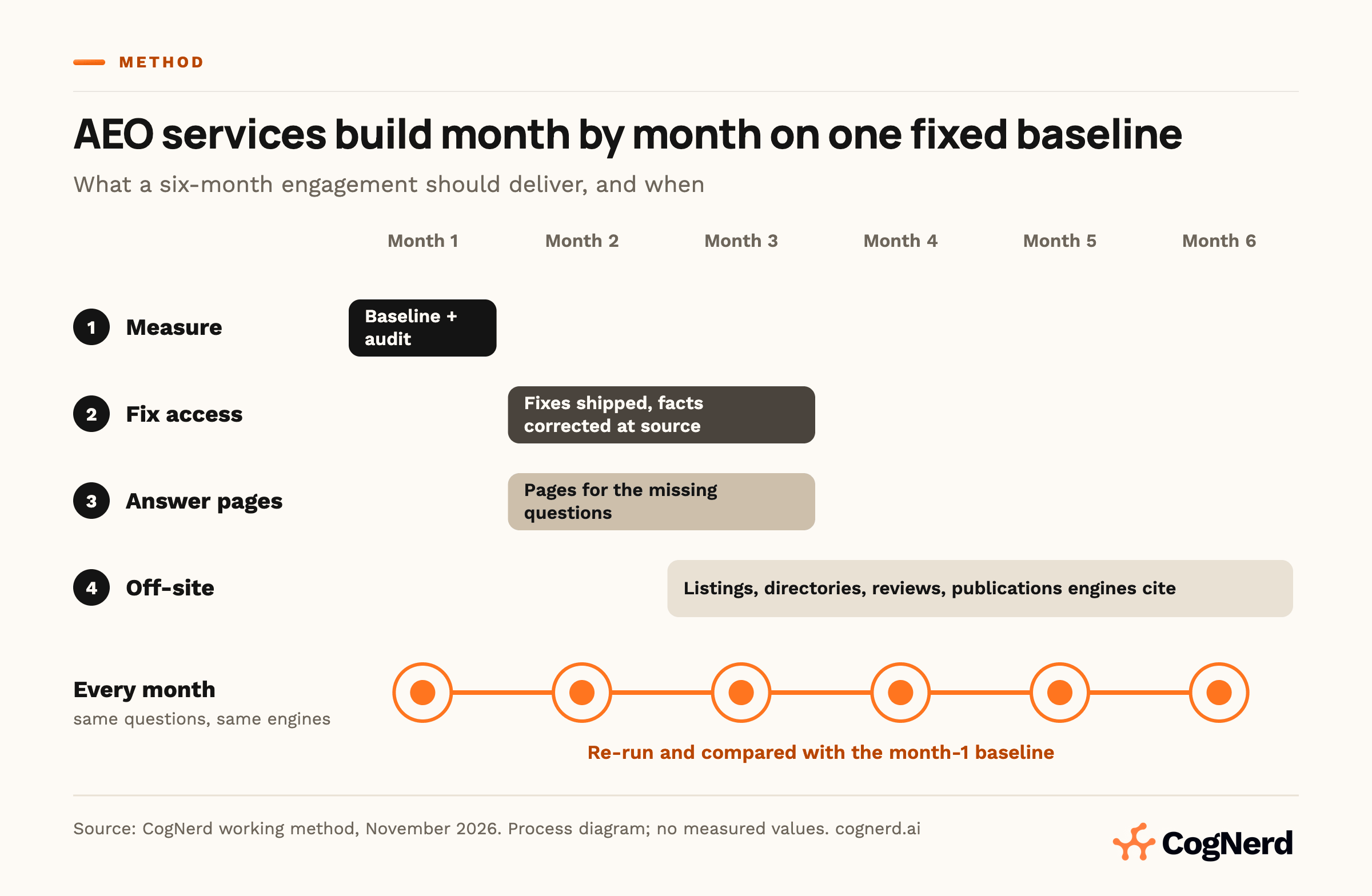
Figure 1. How an AEO service runs month by month. Source: CogNerd's working method, November 2026. Process diagram, no measured values.
- Measurement. Fixed buyer questions, asked on named AI engines on a schedule, every answer stored and checked: mentioned, cited, facts right.
- Technical access. Google says AI Overviews and AI Mode need nothing beyond normal Search: the page must be indexed and eligible to show with a snippet (Google Search Central). OpenAI says sites that opt out of OAI-SearchBot will not be shown in ChatGPT search answers (OpenAI crawler docs). Checks: how AI crawlers read your website.
- Answer content. Pages for the questions where you are missing, written so an engine can lift and quote one passage. Rules in our piece on content that AI models prefer.
- Off-site sources. Consistent facts on the directories, review sites and publications engines already cite in your category. Slowest to move, and often what shifts unbranded answers. See getting your brand mentioned in AI search.
Doing it yourself? The 16 tactics in our AEO best practices guide are the ones a service runs, plus the monthly measurement.
What should AEO services deliver each month?
AEO services should deliver a written report every month: a baseline and technical audit in month one, shipped fixes and new answer pages in months two and three, off-site work from month three, and a re-run of the same questions on the same engines every month.
| Month of the AEO engagement Deliverable you should receive How you can check it |
| Month 1 | Baseline report: question set (mostly unbranded), engines, run dates, mention, citation and accuracy results, the competitors that appear instead of you | You can open the raw answers behind every number |
| Month 1 | Technical audit: crawler access by engine, indexability, facts trapped in images or scripts, schema and entity details | Each issue names a URL and a fix |
| Months 2 to 3 | Technical fixes shipped; wrong facts traced to their source and corrected there | A change log with dates |
| Months 2 to 3 | New or rewritten pages for the highest-value missing questions | Each page maps to named questions in the set |
| Months 3 to 6 | Off-site work: listings, directories, review profiles, mentions on sources engines cite | A list of sources touched and their status |
| Every month | Re-run of the same questions on the same engines, compared with the baseline | Same question set and engines as month 1, or the changes are listed |
Two rules make it work:
- Freeze the question set before work starts. Change them and the trend line means nothing; add new ones as a separate group.
- Log changes on both sides: what the provider shipped and what the engines changed. With only one log, nobody can say why a number moved.
Comparing proposals? Ask us to run your baseline question set and hold each provider's month-one deliverable against it.
How do you measure AEO results?
AEO results are measured on answers, not rankings: how often AI engines mention your brand, cite your pages and get your facts right on questions that do not contain your name. Our guide on how to measure AEO defines ten metrics; a monthly AEO report needs four.
| Monthly AEO report line What it tells you Why it misleads when read alone |
| Unbranded mention rate | Whether buyers who do not know you will find you | Small question sets swing a lot month to month |
| Branded mention rate | Whether engines know your name and facts | Almost always high; shows recognition, not discovery |
| Citation rate (your site linked as a source) | Whether your pages are being used as evidence | Engines that answer from memory cite nothing |
| Accuracy issues | Wrong prices, locations, features or founders in answers | Needs a person to check against your real facts |
SparkToro and Gumshoe had 600 volunteers run 12 prompts 2,961 times through ChatGPT, Claude and Google's AI answers. For ChatGPT and Google's AI, the chance of seeing the same brand list twice was under 1 in 100; Claude did slightly better (SparkToro, 27 Jan 2026). Ask any provider how many times per engine it ran each question.
What does an AEO audit catch in the first month?
A first-month AEO audit catches problems a percentage hides. In CogNerd's October 2026 scans, both of the most useful findings came from a person reading the answers: a question set measuring the wrong market, and a brand's sale line copied in as its name.
- A wedding caterer whose question set measured the wrong market. In the first set (run 10bb9d17, 27 Oct 2026, 3 engines), 12 of the 23 questions named cities the caterer does not serve, so half of every later "improvement" would have been measured in the wrong cities.
- A D2C skincare brand whose sale line became its name. The homepage title was a seasonal sale line, and our schema generator copied it in as the Organization name in every block. (Audit tied to run 11f2b9dc, 23 Oct 2026.)
One scan of cognerd.ai produced four different correct headlines, as our guide to generative engine optimization tools shows. When a provider shows you a percentage, ask what they read to get it.
How long does AEO take to show results?
AEO results arrive at different speeds because each engine gets its answer from a different place. Expect a baseline within weeks, crawler fixes within days, new pages and corrected facts within weeks of a re-crawl, and off-site sources over months. Engines also change their sources without notice.
- Crawler fixes: fast. OpenAI says a robots.txt change takes about 24 hours to reach ChatGPT search (OpenAI).
- Answers from model memory: our August scan of cognerd.ai ran without web retrieval, so every answer came from what each model already knew. Publishing changes nothing there until the model is retrained or replaced.
Search Engine Land reported on 16 Nov 2026, using Muck Rack's Generative Pulse data, that ChatGPT's citations of AP, TIME, TechCrunch, the LA Times and The Atlantic fell 50% to 90% within a week of OpenAI rolling out GPT-5.6 on 9 Jul. Earlier drops followed GPT-5.4 Thinking in March and GPT-5.5 Instant in May (Search Engine Land, 16 Nov 2026).
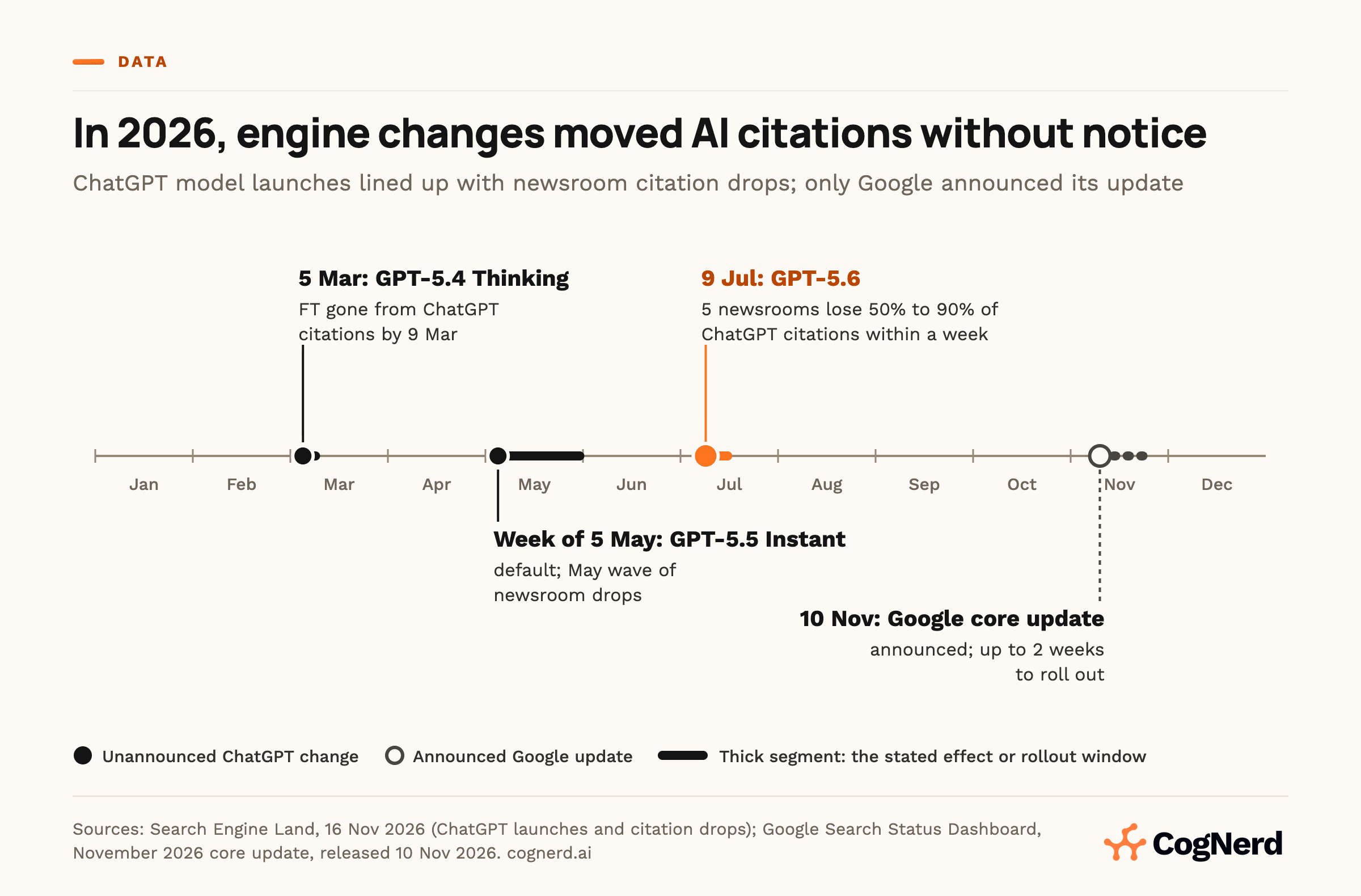
Figure 2. Engine changes that moved AI citations in 2026. Sources: Search Engine Land, 16 Nov 2026 (ChatGPT); Google Search Status Dashboard (core update, 10 Nov 2026, up to 2 weeks to roll out).
Google does announce its core updates; the November 2026 one began on 10 Nov (Google Search Status Dashboard). A good provider checks both calendars before taking credit or blame. If one engine drops while your Google rankings hold, suspect the engine first.
What are the red flags in an AEO services proposal?
The red flags in an AEO services proposal are promises an AEO provider cannot keep and measurement it will not let you check. Any one of the five below is reason enough to ask for a revised scope in writing.
- Guaranteed citations or a "top spot in ChatGPT". No one controls how an engine picks sources.
- One blended visibility score. Ask for branded and unbranded on separate lines.
- A question set you cannot see or keep. The questions and answers are your baseline; you should be able to export them.
- Content volume as the headline deliverable. A page helps only when it answers a named missing question.
- No engine list. "All AI platforms" is not a scope.
Should you hire an AEO agency or do AEO in-house?
Hire an AEO services provider if nobody on your team has a few hours a week for this work; run AEO in-house if someone does. Either way, own the measurement: the question set, the engine list and the stored answers, so changing providers costs you no history.
- In-house: a tracker runs the questions and keeps the history; your marketer ships the fixes.
- Service: a provider does the audit, fixes, pages and off-site work, and reports monthly against the frozen baseline.
- Hybrid: you own the tracker and question set; a provider does the work.
Hiring in India? Take the proposal red flags above into the first call when choosing an AEO provider in India.
What AEO services does CogNerd offer?
CogNerd offers AEO services two ways: a platform that runs a brand's question set across 5+ AI engines, reports branded and unbranded results separately, shows each answer's sources and turns gaps into content briefs, plus AEO and GEO services from our team on the same scans. Disclosure: CogNerd sells both.
Want a baseline before you talk to any provider, us included? Get your free AI visibility audit. The question set and results are yours to keep. Running it yourself? Our AI visibility tracker guide shows what to log every week.
About the author. Aman Mundra is Founder & CEO of CogNerd. He spent about ten years as a machine learning engineer, including four years at PayPal, before building CogNerd to measure how brands appear in AI answers.
Last updated: 20 Nov 2026
Sources
- Search Engine Land (data: Muck Rack Generative Pulse), 16 Nov 2026: https://searchengineland.com/chatgpt-citation-drops-unannounced-google-core-updates-501912
- Google Search Status Dashboard, November 2026 core update, 10 Nov 2026: https://status.search.google.com/incidents/WLxcJyC6jMWMfryxsKMc
- Google Search Central, "AI features and your website", read 19 Nov 2026: https://developers.google.com/search/docs/appearance/ai-features
- OpenAI, "Overview of OpenAI crawlers", read 19 Nov 2026: https://developers.openai.com/api/docs/bots
- SparkToro (with Gumshoe), 27 Jan 2026: https://sparktoro.com/blog/new-research-ais-are-highly-inconsistent-when-recommending-brands-or-products-marketers-should-take-care-when-tracking-ai-visibility
- CogNerd scans, first-hand: runs 10bb9d17 (wedding caterer, 27 Oct 2026), 11f2b9dc (D2C skincare brand, 23 Oct 2026), ecbf43a5 (cognerd.ai, 12 Aug 2026, 6 engines, no web retrieval).
FAQ
Related articles

FAQ
Quick answers on CogNerd, AI search optimization, AEO, GEO and SEO.
See how AI search sees your brand.
Run a free AI visibility scan and see exactly where your brand stands today against your top 3 competitors, engine by engine.
Visibility report
Visibility score
61.4baseline
Engines citing you
2 / 5
Top gap“best {your category} platform”