Google AI Search Reaches 1 Billion Users: Why Businesses Must Optimize for AI Search Now
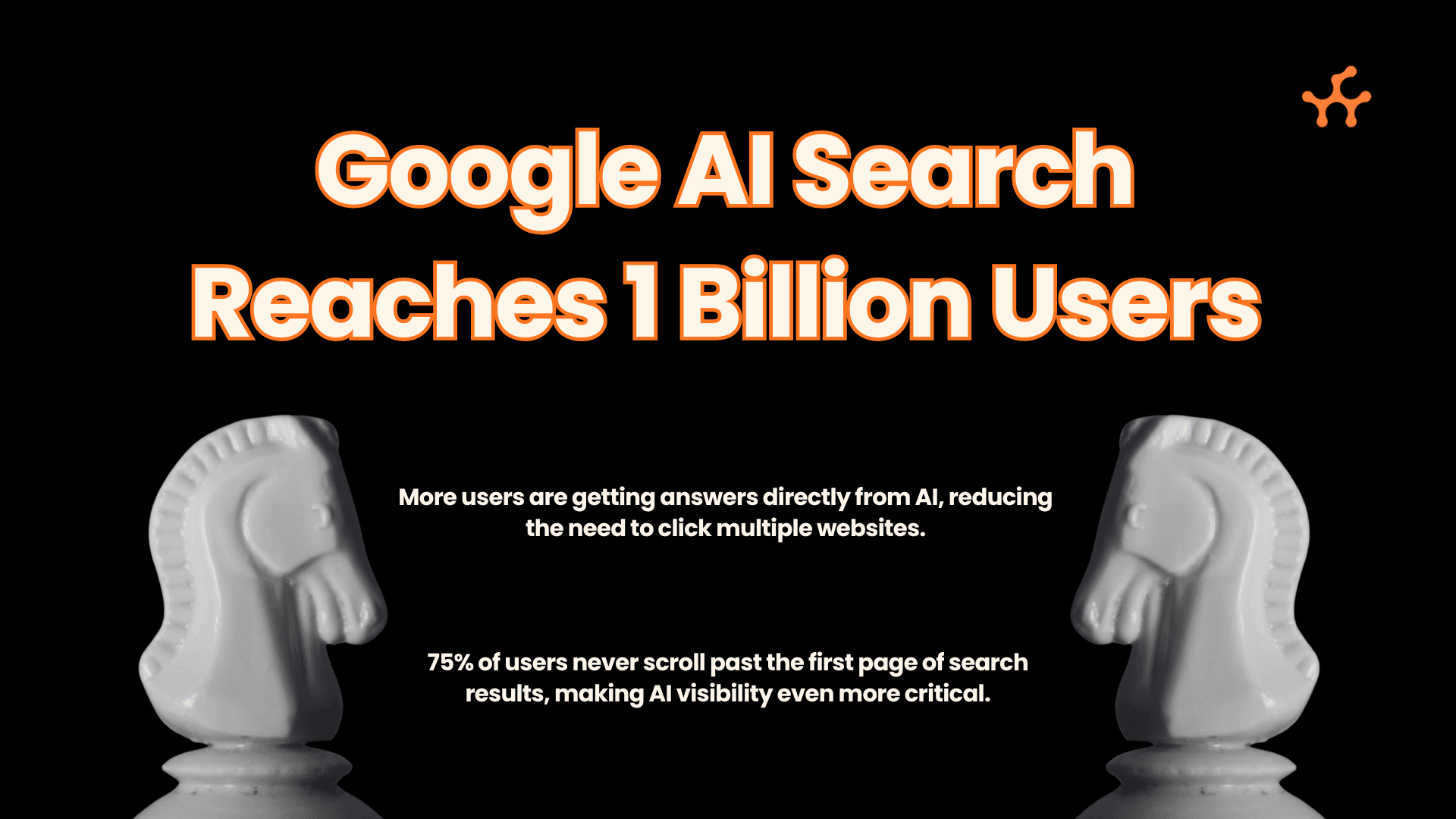
Google AI Search now reaches over 1 billion users, changing how people discover brands online. Learn why AI Search Optimization is essential to stay visible in the AI-first search era.
- Google AI Search reaching 1 billion users signals that AI-powered search is now mainstream.
- Traditional SEO remains essential, but it is no longer enough to maximize online visibility.
- AI Search Optimization helps businesses become discoverable across Google AI Overviews, ChatGPT, Gemini, Claude, and Perplexity.
- Answer Engine Optimization (AEO) improves the chances of your content appearing as direct answers to user queries.
- Generative Engine Optimization (GEO) increases the likelihood of your brand being cited and recommended by AI systems.
- High-quality, original, and trustworthy content is more likely to be referenced by AI-powered search engines.
- Building topical authority through interconnected, in-depth content strengthens both search rankings and AI visibility.
- Structured content, clear headings, schema markup, and concise answers make it easier for AI systems to understand your website.
- AI visibility is becoming a new marketing KPI alongside rankings, traffic, and conversions.
- Businesses that adopt SEO, AEO, and GEO together will be better positioned to succeed as AI continues to reshape the future of search.
Google Search is undergoing its biggest transformation since its launch. Search results are no longer limited to a list of blue links. Today, users receive AI-generated summaries, product recommendations, and direct answers without having to visit multiple websites.
This shift has accelerated with Google announcing that its AI-powered search experiences now reach more than 1 billion users. AI-assisted search is no longer an emerging feature. It has become a core part of how people discover information, compare products, and make decisions online.
For businesses, this milestone represents more than a technology update. It signals a major change in how online visibility is earned. Ranking on the first page of Google is still valuable, but it is no longer the only measure of success. Brands must now optimize their content so it can be understood, trusted, and referenced by AI systems.
The way people search is changing rapidly. Instead of typing short keywords like "best CRM software," users now ask complete questions such as, "Which CRM is best for a growing startup with a limited budget?" AI search engines are designed to understand these conversational queries and deliver complete answers in seconds.
As AI-generated responses become the new standard, businesses that continue relying only on traditional SEO may find it harder to reach their audience. The future belongs to brands that combine SEO with AI Search Optimization, Answer Engine Optimization (AEO), and Generative Engine Optimization (GEO).
In this guide, we'll explore why Google's AI search milestone matters, how it is reshaping digital marketing, and what businesses should do today to remain visible in the AI-first search landscape.
What Is Google AI Search?
Quick Answer
Google AI Search uses generative AI to understand complex questions and deliver direct, contextual answers alongside traditional search results. It helps users find information faster by summarizing content from trusted sources instead of requiring them to visit multiple websites.
Google has spent years evolving Search from a keyword-based engine into an intelligent assistant. Features like Featured Snippets, Knowledge Panels, and AI Overviews have gradually changed how users interact with search results.
Instead of simply matching keywords, Google now focuses on understanding user intent. Someone searching for "best project management software" is often looking for recommendations, pricing, comparisons, and reviews. AI Search brings this information together into a single, easy-to-read response.
This creates a faster experience for users while encouraging businesses to publish content that is comprehensive, well-structured, and trustworthy.
Why 1 Billion Users Is a Defining Moment
Reaching one billion users demonstrates that AI-powered search has moved into the mainstream. Millions of people now rely on AI-generated answers every day to research products, solve problems, and learn new topics.
Several factors have fueled this rapid adoption.
- People receive answers instantly instead of opening multiple webpages.
- Conversational search feels more natural than typing short keywords.
- AI can summarize large amounts of information in seconds.
- Search experiences are becoming more personalized and context-aware.
For businesses, this means visibility is no longer determined only by rankings. Content must also be clear enough for AI systems to understand and authoritative enough for them to trust.
Companies that adapt to this shift early will be better positioned as AI becomes the primary way people search online.
How AI Search Is Changing User Behavior
Search behavior has evolved significantly over the past few years.
Traditional searches were usually short and keyword-focused.
Examples include:
- digital marketing agency
- SEO tools
- CRM software
- best laptops
Today, users are asking detailed questions that sound like conversations.
For example:
- Which SEO platform is best for a SaaS startup?
- How can I improve my brand's visibility in ChatGPT?
- What is the difference between SEO, AEO, and GEO?
- Which AI marketing tools are worth investing in this year?
Users expect complete answers instead of a collection of links. They want recommendations, comparisons, and explanations that help them make informed decisions immediately.
Businesses must create content that answers these questions clearly and demonstrates genuine expertise.
The Rise of Zero-Click Search
Quick Answer
Zero-click search happens when users get the information they need directly on the search results page without clicking through to a website. AI-generated answers are making this behavior more common across informational searches.
Featured Snippets introduced the concept of answering questions directly within Google Search. AI Overviews take this further by generating detailed summaries using information from multiple trusted sources.
For publishers and businesses, this changes the way success is measured.
Traffic remains important, but being featured in AI-generated answers can significantly increase brand awareness and credibility. A brand that is consistently referenced by AI platforms is more likely to influence customer decisions, even before a website visit occurs.
Instead of optimizing only for clicks, businesses should optimize for visibility wherever users interact with AI-powered search.
Why Traditional SEO Is No Longer Enough
Search Engine Optimization remains the foundation of digital visibility. Strong technical SEO, high-quality content, backlinks, and positive user experience continue to influence search rankings.
However, AI-powered search evaluates content differently.
It looks beyond keywords and considers whether information is reliable, well-organized, and easy to understand.
Content that performs well in AI search usually includes:
- Clear explanations
- Accurate information
- Logical structure
- Original insights
- Credible sources
- Strong topical authority
- Consistent updates
Traditional SEO helps search engines discover your content.
AI Search Optimization helps AI systems choose your content as a trusted source.
Businesses that invest in both strategies are better prepared for the future of search.
What Is AI Search Optimization?
Quick Answer
AI Search Optimization is the process of creating content that AI-powered search engines can easily understand, trust, and reference. It combines traditional SEO with structured content, topical authority, and AI-focused optimization techniques to improve visibility across modern search experiences.
AI Search Optimization extends beyond improving rankings on Google.
Its objective is to increase your brand's presence across platforms such as Google AI Overviews, ChatGPT, Gemini, Claude, and Perplexity.
A successful AI Search Optimization strategy combines:
- Search Engine Optimization (SEO)
- Answer Engine Optimization (AEO)
- Generative Engine Optimization (GEO)
- Semantic SEO
- Structured data
- Entity optimization
- E-E-A-T principles
- High-quality, original content
Together, these elements help AI systems determine whether your content is reliable enough to recommend and cite.
Why AEO and GEO Matter More Than Ever
SEO remains essential, but it is no longer the complete strategy.
Answer Engine Optimization focuses on helping AI systems extract concise and accurate answers from your content.
Generative Engine Optimization focuses on increasing the likelihood that AI platforms cite and recommend your brand when responding to user queries.
When combined with SEO, these strategies create a stronger digital presence across both traditional search engines and AI-powered search platforms.
Businesses that embrace SEO, AEO, and GEO together will be better equipped to build authority, increase visibility, and reach users wherever they search.
How Businesses Should Adapt to AI Search
AI-powered search is changing how people discover brands, compare products, and make purchasing decisions. Businesses that continue relying only on traditional SEO may struggle to maintain visibility as AI-generated answers become more common.
The good news is that adapting to AI search doesn't require abandoning your existing SEO strategy. Instead, it means expanding it to include AI-focused optimization.
Here are the key steps every business should take.
Create Content That Answers Questions
Quick Answer
AI search engines prioritize content that directly answers user questions. Writing concise, accurate, and well-structured responses improves your chances of appearing in AI-generated results.
Instead of focusing solely on keywords, build content around the questions your audience is asking.
For example, rather than writing an article titled "CRM Software Features," create content that answers questions like:
- Which CRM is best for small businesses?
- How much does CRM software cost?
- What features should startups look for in a CRM?
This approach improves both user experience and AI visibility.
Build Topical Authority
Publishing a few blog posts is no longer enough.
AI systems prefer websites that consistently demonstrate expertise across an entire topic.
If your business specializes in AI search optimization, your website should cover related subjects such as:
- AI Search Optimization
- SEO
- Answer Engine Optimization
- Generative Engine Optimization
- Google AI Overviews
- AI Visibility
- Semantic SEO
- Structured Data
- AI Citations
When these articles are internally linked, they create a knowledge hub that signals expertise to both search engines and AI models.
Focus on Trust and Credibility
AI systems are designed to prioritize reliable information.
Businesses should strengthen trust by:
- Publishing original research and insights
- Including author information and credentials
- Referencing authoritative sources
- Updating outdated content regularly
- Maintaining consistent branding across digital channels
Content backed by real expertise is more likely to be referenced than generic, AI-generated articles with little substance.
Common Mistakes Businesses Make
As AI search continues to grow, many organizations are making the same mistakes.
Treating AI Search as a Trend
Some businesses assume AI search is just another temporary feature.
In reality, conversational search is becoming a standard way people interact with information online. Ignoring this shift could reduce your brand's visibility over time.
Writing Only for Keywords
Keyword optimization remains important, but stuffing articles with repeated phrases no longer works.
Modern search systems understand context, entities, and user intent. Focus on solving problems instead of repeating the same keyword.
Publishing Generic Content
Thousands of articles covering the same topic are published every day.
If your content offers nothing new, AI platforms have little reason to reference it.
Instead, publish:
- Original opinions
- Industry insights
- Case studies
- Research
- Customer stories
- Practical frameworks
Unique content helps your brand stand out.
Ignoring Content Updates
Search and AI platforms favor fresh information.
Review your highest-performing pages regularly to:
- Update statistics
- Improve examples
- Add new insights
- Remove outdated recommendations
- Expand sections based on new trends
Content should evolve as the industry changes.
AI Visibility Is Becoming a New Marketing KPI
For years, marketers measured success using metrics such as:
- Organic traffic
- Keyword rankings
- Click-through rate
- Backlinks
- Conversions
These metrics remain valuable, but they no longer tell the complete story.
Businesses should also track how often they appear in AI-generated responses.
Questions worth asking include:
- Is my brand mentioned in Google AI Overviews?
- Does ChatGPT recommend my products or services?
- Does Gemini reference my content?
- Is my business visible in Perplexity searches?
- Which competitors receive more AI citations than we do?
These insights help businesses understand how AI platforms perceive their authority within a specific industry.
As AI search adoption grows, AI visibility will become an important performance metric alongside traditional SEO.
How CogNerd Helps Businesses Succeed in AI Search
AI search requires a different approach than traditional SEO.
At CogNerd, we help businesses understand and improve how they appear across AI-powered search platforms.
Our platform enables organizations to:
- Track AI visibility across leading AI search engines
- Monitor brand mentions and AI citations
- Identify content gaps
- Analyze competitor visibility
- Discover optimization opportunities
- Improve AEO and GEO performance
- Measure AI search growth over time
Rather than focusing only on rankings, CogNerd helps businesses understand how AI systems interpret, recommend, and reference their brand.
This enables marketing teams to make informed decisions and stay competitive in an AI-first search landscape.
The Future of Search Is AI Powered
Search is becoming more conversational, personalized, and intelligent.
People increasingly expect complete answers instead of a list of links. AI-powered search engines are responding by summarizing information, recommending products, and guiding users through complex decisions.
For businesses, this means success will depend on more than ranking well.
Brands must create content that is:
- Helpful
- Accurate
- Well-structured
- Trustworthy
- Easy for AI systems to understand
Organizations that embrace this shift today will build stronger authority and remain visible as search continues to evolve.
Those who wait may find it increasingly difficult to compete for attention in an AI-driven search environment.
Conclusion
Google AI Search reaching more than one billion users marks a significant milestone in the evolution of online search. It reflects a broader shift in how people discover information, evaluate brands, and make decisions.
Traditional SEO continues to play a critical role, but it is no longer enough on its own. Businesses must also optimize for AI-powered search experiences by creating content that is clear, authoritative, and easy for AI systems to understand.
The companies that invest in AI Search Optimization, Answer Engine Optimization, and Generative Engine Optimization today will be better positioned to build trust, increase visibility, and stay competitive as AI reshapes the digital landscape.
The future of search has already begun. The question is not whether businesses should adapt. The question is how quickly they can.
Ready to Improve Your AI Visibility?
As AI search becomes a primary discovery channel, understanding how your brand appears across platforms is more important than ever.
CogNerd helps businesses measure AI visibility, monitor AI citations, analyze competitors, and optimize content for Google AI Overviews, ChatGPT, Gemini, Claude, and Perplexity.
If you're ready to future-proof your search strategy, start optimizing for AI search today with CogNerd.
FAQ
Related articles
FAQ
See how AI search sees your brand.
Run a free AI visibility scan and see exactly where your brand stands today against your top 3 competitors, engine by engine.
Visibility score
Engines citing you